

Guide
Developing on Wetlands in South Carolina: What to Know First
How to build near wetlands in South Carolina, spotting them, delineation, the Army Corps jurisdictional determination, SWPPP and 404/401 permits, and realistic costs. From a licensed SC home builder.
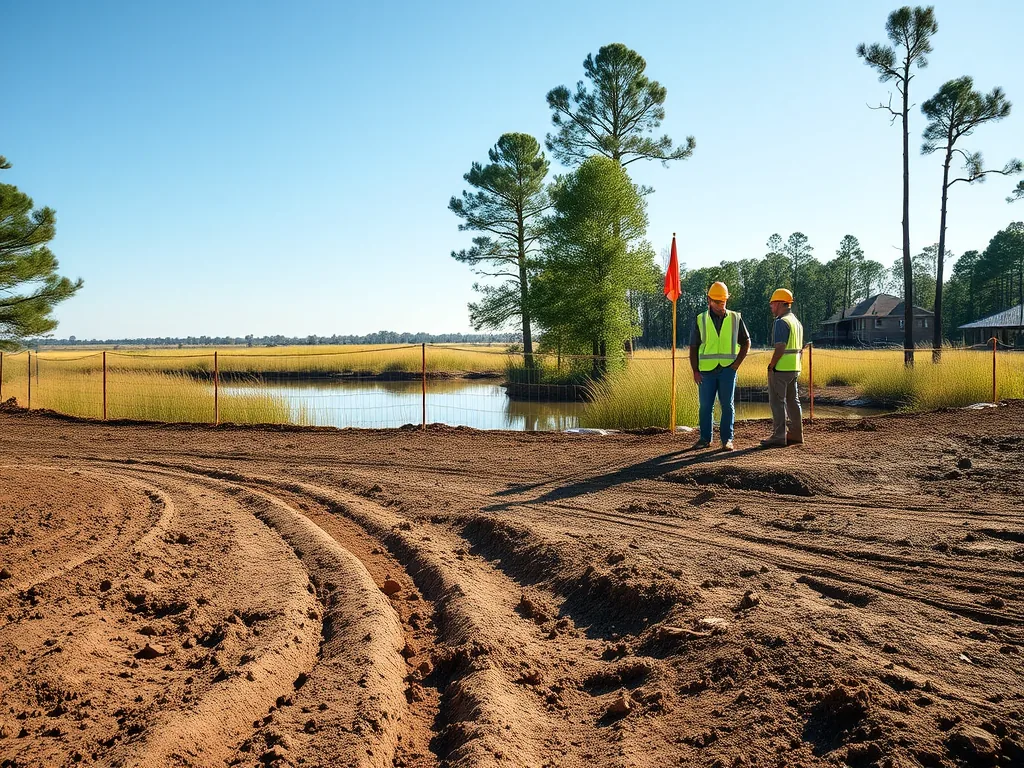
Building on or near a wetland in South Carolina is doable, but only in the right order, with the right agencies, before you clear or grade. Get the sequence wrong and you're looking at stop-work orders and fines. Here's the path we follow.
Chonko Construction is a licensed South Carolina home builder (license #52210). On any site with wetland features, we coordinate the survey, engineering, and permitting and put the whole plan in writing before work starts.
Step 1. Identify wetlands before you touch the ground
Start with a desktop review of the U.S. Fish & Wildlife National Wetlands Inventory (NWI), look for polygons labeled "palustrine," "emergent," or "riverine." On site, watch for standing water, hydric soils with gray or rust staining, and water-tolerant plants like cattails, rushes, willows, and cypress in low, drainage-connected areas.
Step 2. Order a professional delineation
A qualified biologist marks the wetland boundary using vegetation, soils, and hydrology, following the U.S. Army Corps 1987 Manual and regional supplements. Your surveyor then locates those flags for the plan sheets. (Typical delineation: $1,500–$3,500.)
Step 3. Request an Army Corps Jurisdictional Determination (JD)
Submit the delineation maps, data forms, and photos to the U.S. Army Corps of Engineers (Charleston District). The JD confirms whether the features are federally regulated "Waters of the U.S." under Section 404. Processing usually runs 30–90 days, and a JD is generally good for several years unless conditions change.
Step 4. SWPPP, stormwater, and grading plans
Your civil engineer folds the wetland boundary into the site design and prepares a Stormwater Pollution Prevention Plan (SWPPP). In South Carolina, a SWPPP and NPDES Construction General Permit coverage are mandatory once land disturbance reaches one acre (or is part of a larger plan over one acre). The SWPPP covers plan sets, best management practices (silt fence, inlet protection, sediment basins, check dams), phasing, weekly and post-rain inspections with logs, concrete-washout and spill controls, and final stabilization. Near wetlands, it also has to show buffers, tree-protection fencing, and clean-water routing around the work zone.
Step 5. Bring in an engineer (and budget for it)
A licensed civil engineer ties together the wetland lines, grading, stormwater routing, and SWPPP. Rough budgets for a single lot near wetlands: SWPPP sheets from about $15,000+, and full site plans around $40,000+ for roughly 4 acres with wetland considerations. It's modest next to the cost of an enforcement action.
Step 6. If impact is unavoidable
The Corps may authorize minimal impacts under a Nationwide Permit; larger impacts need an Individual Permit, plus state 401 Water Quality Certification. Compensatory mitigation credits typically run $30,000–$60,000 per acre depending on watershed and credit type.
Readiness checklist
- Check the NWI and walk the site after rain
- Hire a biologist to delineate; have the surveyor locate the flags
- Request a JD from the USACE Charleston District
- Engage a civil engineer for grading/drainage and a compliant SWPPP
- Phase clearing so BMPs are in before soil is exposed
- Protect tree buffers and root zones
- Keep inspection logs and stabilize each phase
Frequently asked questions
Can you build on wetlands in South Carolina? Often yes, but only after delineation and an Army Corps jurisdictional determination, and any unavoidable impact needs a Section 404 permit (and state 401 certification). The work has to be planned around the wetland, not through it.
When is a SWPPP required? Once land disturbance hits one acre, or is part of a larger plan over an acre, a SWPPP and NPDES coverage become mandatory.
Have a site with wet, low ground? Book a free phone consultation and we'll map out the steps and the team you'll need before anything gets cleared.
Have a project in mind?
See the full scope and pricing, or book a free phone consultation. No estimate pressure.