

Comparison
Retaining Wall or Better Grading? How to Tell Which One You Need
A wall and a regrade solve different problems. The slope test, the drainage test, and the three questions that tell you which one your Midlands yard actually needs.
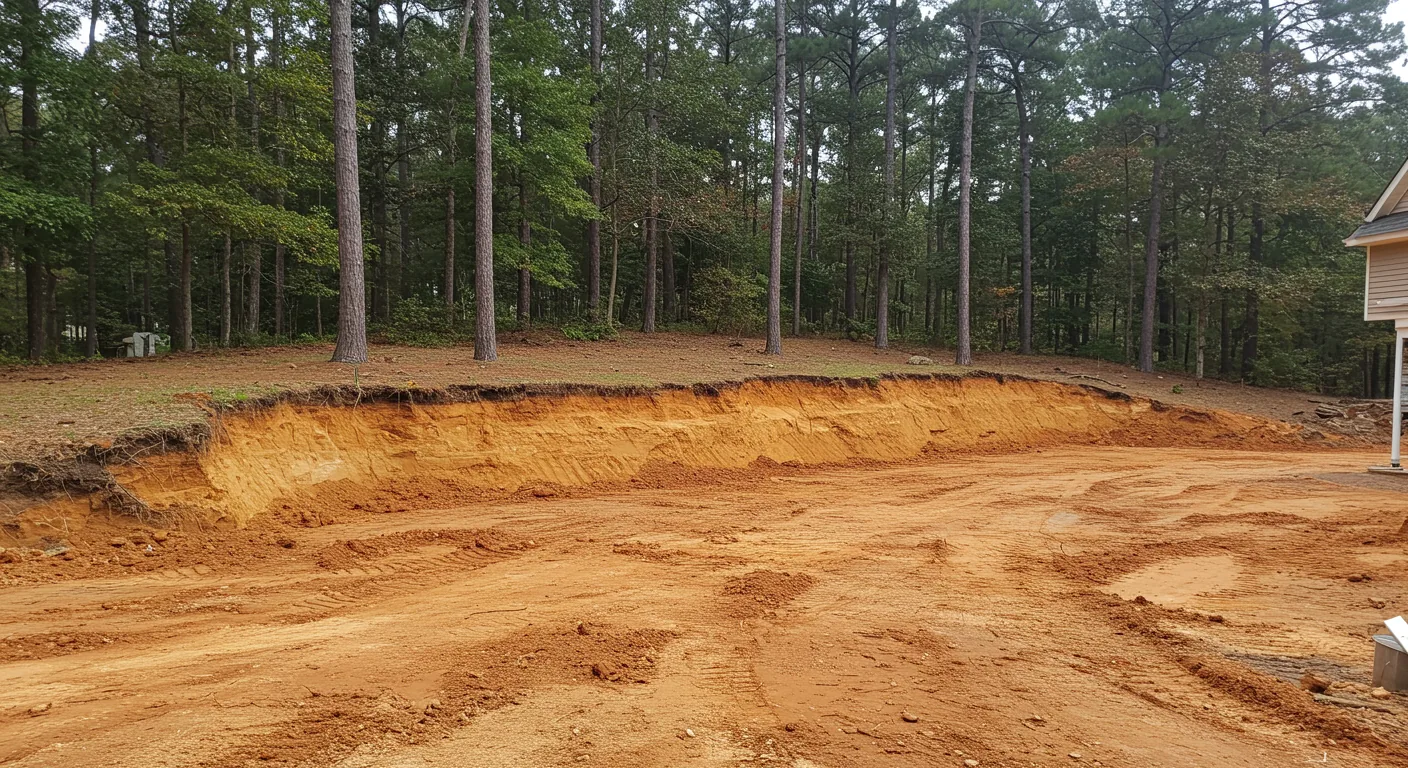
Short answer: if the slope has room to be flattened, grading is the cheaper and more durable fix. If the grade change is tall and tight, or the slope is already moving, you need a wall. Most Midlands yards we look at need grading, and the wall quote they came in with was solving the wrong problem.
As a licensed South Carolina home builder (license #52210) doing site work across Columbia, Lexington, Chapin, and Irmo, here is how we tell the two apart.
What grading actually is
Grading is not pushing dirt until the yard looks better. It is setting the water path and staying inside the soil's stable limit. A real grading scope covers:
- Resloping so water leaves the foundation, the patio, and the low corners
- Cut and fill balanced on site so you are not paying to haul dirt in or out
- Compaction, so what you shaped stays shaped
- Swales, the shallow channels that carry runoff to somewhere safe
- Finish grading for sod, seed, gravel, or hardscape
- Tie-ins where your grade meets the neighbor's, the driveway, or the house
The number that decides it: angle of repose
Angle of repose is the steepest angle a soil can sit at and stay put. It is not one fixed number. It moves with moisture, compaction, grain shape, and clay content. That is the whole problem with our soil: Columbia clay holds a steep face when it is dry and gives it up when it saturates. The slope does not fail on a sunny day. It fails three weeks later, after a long rain.
| Material | Stable angle | What it means here |
|---|---|---|
| Loose, dry sand | 30 to 35 degrees | Wants a flatter slope or reinforcement |
| Rounded gravel | 25 to 35 degrees | Rolls and migrates, needs edging |
| Angular crushed stone | 35 to 45 degrees | Interlocks well, but the base prep has to be right |
| Silty sand | 30 to 35 degrees | Fine compacted, erodes under concentrated runoff |
| Lean clay | 25 to 35 degrees | Steep when dry, weak when wet |
| Wet, loose excavated clay | 15 to 25 degrees | High slump risk, needs drainage and reinforcement |
If your slope is sitting near the top of its range and the drainage is dumping onto it, you do not have a landscaping problem. You have a stability problem.
When grading alone is the answer
Water is running toward the house. The code baseline is 6 inches of fall in the first 10 feet away from the foundation (International Residential Code R401.3). Regrading and correcting the discharge fixes this outright. No wall involved.
The yard holds water after a rain. A flat yard with soggy corners usually needs a subtle pitch and a swale to a safe outlet, not piping and not block.
The slope is stable but shedding topsoil. If the face is sound and the problem is concentrated runoff cutting rills, reshape to spread the water and protect the surface with vegetation or matting.
You are building something on it. Decks, patios, pavers, and fences all need the ground and the water path set before anything goes in. That is grading, and it comes first.
When you actually need a wall
- The grade change is tall and tight. You need usable flat space and there is not enough run to get it by sloping.
- The slope is already moving. Slumping, cracking, soil creep, or the same failure repeating after every heavy rain.
- The slope is at or past its stable angle. Steep face, poor compaction, weak soil.
- You are boxed in. A lot line, driveway, fence, or structure means you cannot flatten it even if you wanted to.
- Water is building up behind the slope. Trapped water pushes outward, and that pressure is what tips old landscape walls.
That last one is worth sitting on. Around here, walls do not usually fail because the block was wrong. They fail because nobody built the drainage behind them. A wall without base prep, drainage aggregate, and a real outlet is not a question of if.
The three questions
- Is there room to flatten it? If yes, and drainage and compaction are handled, grading is the first move.
- Do you lose space you need? If flattening eats the yard, the patio, or the driveway, a retaining solution is the right call.
- Is it actively failing? Then it is usually both: regrade to take the angle down, then a wall or reinforced system to lock it.
Drainage is the variable most quotes skip
Grading and drainage are one system. A complete plan has to answer where water sheets across the surface, where the downspouts discharge and what that does to the slope, whether there is subsurface water driving the movement, and where the water finally exits without becoming someone else's problem. A grading quote that does not mention any of that is a dirt-moving quote.
What it costs
Grading is priced on the dirt moved, the slope, the access, and how far material has to travel. A wall is priced on material, base prep, drainage, and engineering if it is tall enough to need it. Our per-square-foot number for walls is in the retaining wall cost guide, and grading and excavation are broken out in the excavation cost guide.
The expensive mistake is not the price of either one. It is buying a wall to solve a grading problem, or buying grading that cannot hold because the slope is past what the soil will carry.
How we scope it
Before anyone quotes block, we walk five things: where the water goes now versus where it should go, the slope geometry against the stable angle, how the soil behaves wet, the constraints (lot lines, utilities, trees, driveways), and what the finished surface has to be. Then the scope gets written down, both stages separately, so you can see what you are paying for.
Sorting out a slope or a drainage problem in Columbia or the Midlands? Book a free phone consultation and we will tell you which of the two you are actually looking at.
Frequently Asked Questions
Do I need a retaining wall or just better grading?add
If there is room to flatten the slope and handle the drainage, grading is usually the better and cheaper fix. A wall is the right tool when the grade change is tall and tight, the slope is already moving, or a lot line or driveway means you cannot flatten it.
Why do slopes fail after the rain instead of during it?add
Saturation reduces the friction and cohesion holding the soil together. Columbia clay will stand at a steep face while it is dry and lose that strength once water works through it, so the failure shows up after a long rain rather than during the storm.
How much fall does the ground need away from a foundation?add
The code baseline is 6 inches of drop within the first 10 feet from the foundation wall (International Residential Code R401.3). Water running back toward the house is a grading correction, not a wall.
Why do retaining walls fail in the Midlands?add
Almost always drainage. Water builds up behind the wall and pushes outward. A wall built without base prep, drainage aggregate, and a real outlet point is on a clock.
Have a project in mind?
See the full scope and pricing, or book a free phone consultation. No estimate pressure.