

Guide
Above-Grade Footers vs. Buried Deck Posts in Columbia, SC
Why a deck post set on an above-grade footer outlasts one buried in Columbia's red clay, how it stops rot, what the hardware costs, and what we build. From a licensed SC home builder.
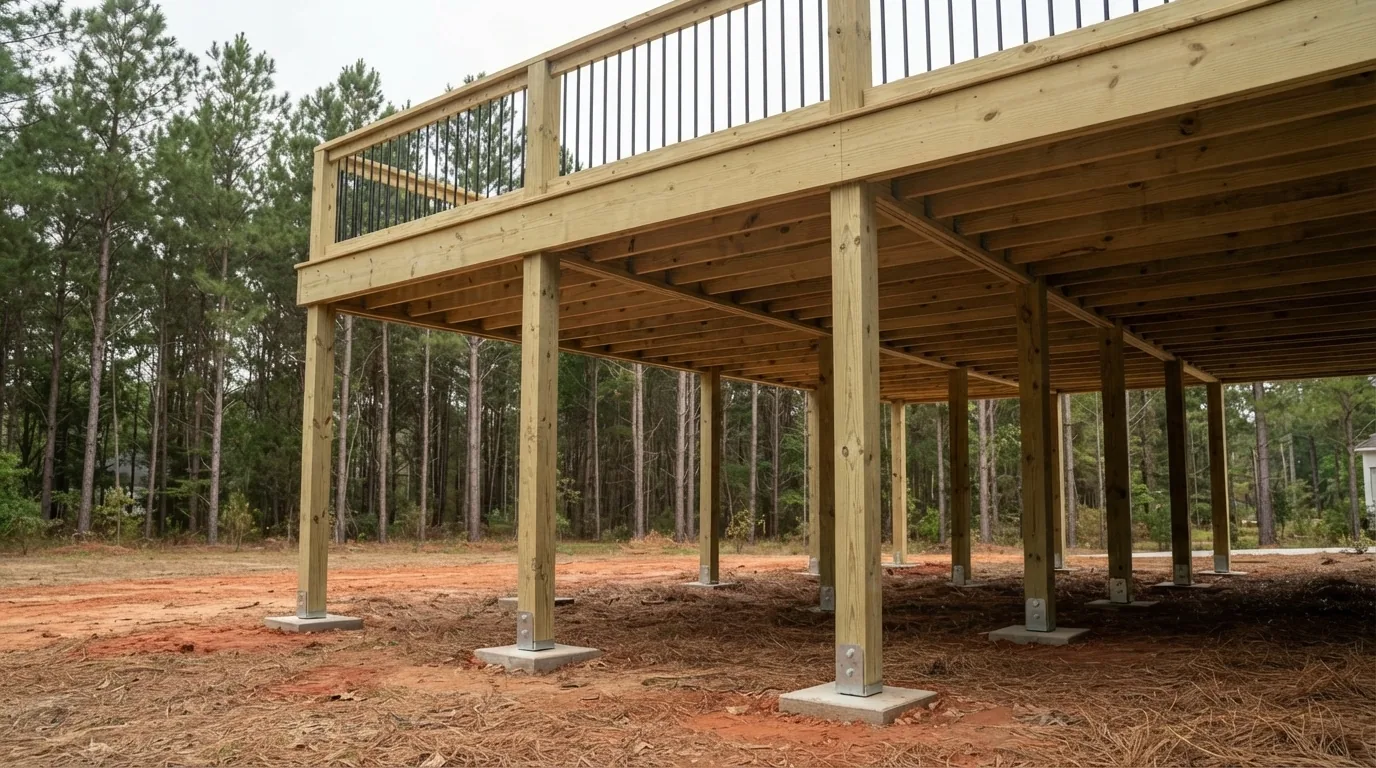
How you set a deck's posts is the single biggest decision for how long that deck lasts in the Midlands. The old way, burying posts in concrete or soil, is exactly why so many Columbia decks rot out at the base years before the rest of the structure wears out. The modern standard, and what we build, keeps wood up off the ground on a metal base so it can dry.
Chonko Construction is a licensed South Carolina home builder (license #52210). We build and replace decks across Columbia and the Midlands.
The three ways to set a post
Buried posts sit directly in soil or encased in concrete below grade. A concrete collar is the middle path: the post still goes down the hole, but the concrete carries up past grade with a crowned top, so the wood leaves the concrete above the wet zone instead of inside it. Above-grade footers stop the concrete at ground level and set the post on top of it in a metal base, holding the wood a fraction of an inch clear of the footing.
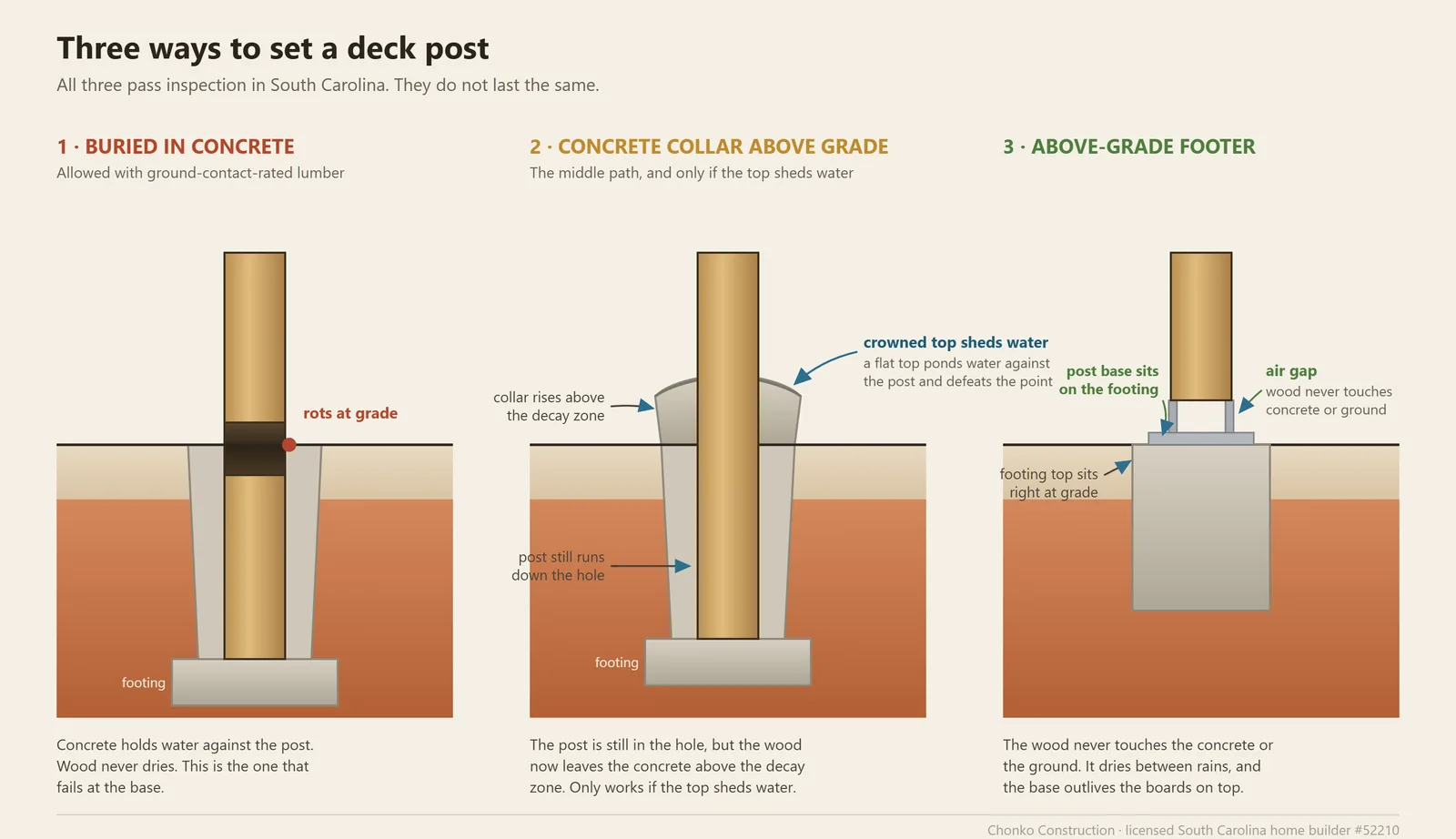
Worth being straight about the code here, because a lot of deck articles get this wrong: burying a post is allowed. The International Residential Code (R317.1.2) permits wood in contact with the ground, or embedded in concrete that touches the ground, as long as it is pressure-treated and rated for ground-contact use, which is a heavier treatment than the standard above-ground lumber most people picture. The code allows the other route too, since a post set on a pier or metal pedestal above the earth is not in ground contact at all. All of them pass inspection. They do not all last the same.
Why buried posts rot in South Carolina
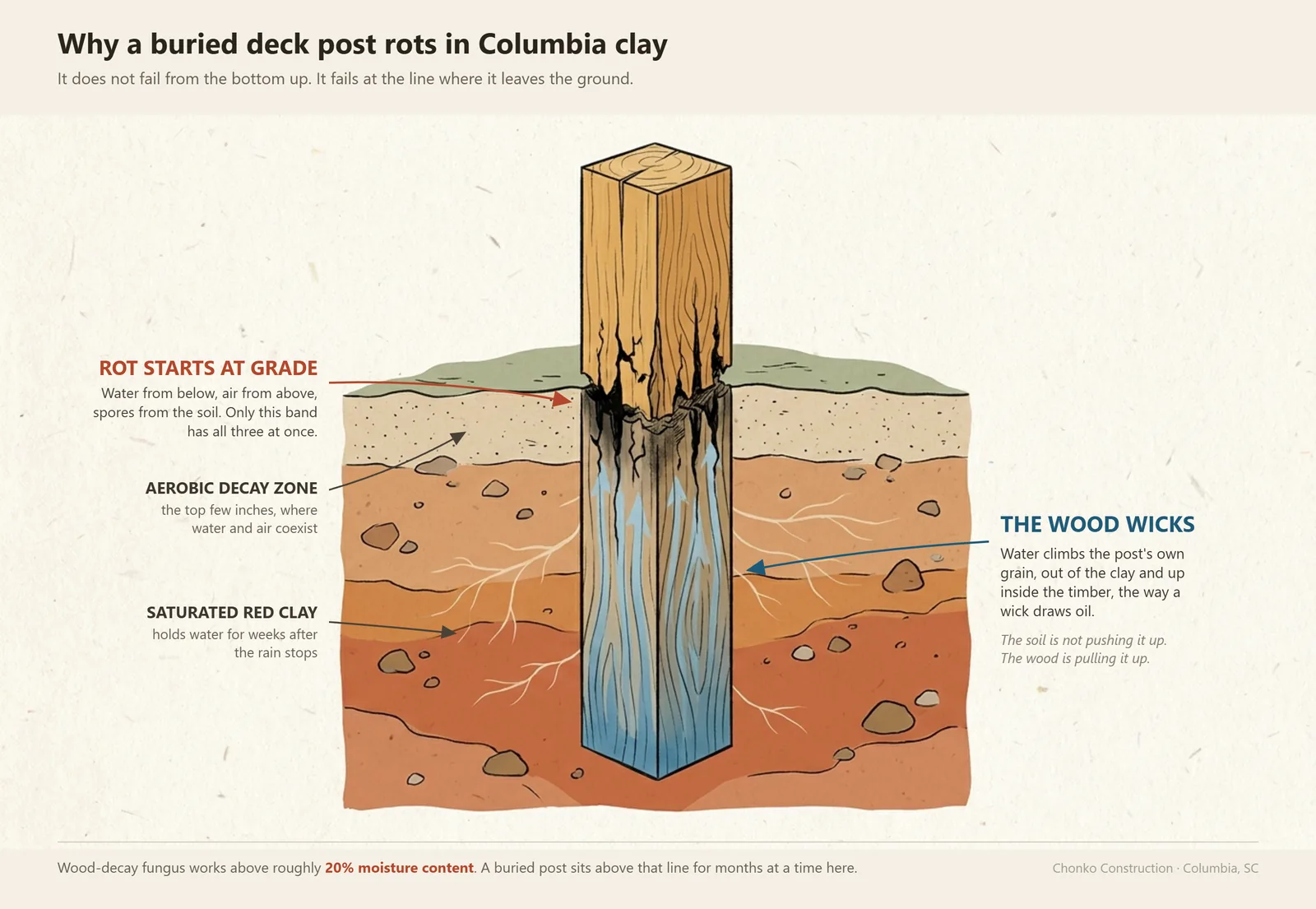
Wood decay needs oxygen and moisture together. That combination lives in the top few inches of soil, the "aerobic decay zone" where the U.S. Forest Service notes most wood-decay fungi are active. Two things make it worse here:
- The wood does the wicking. Timber pulls water up through its own end grain and cell structure, the way a paper towel pulls up a spill. The buried section of the post draws moisture out of the soil and carries it upward into the part of the post you can see, so the wood stays saturated even when the surface of the yard looks bone dry.
- Columbia's red clay holds that moisture, and our long humid summers keep the post above the ~20% moisture content where fungus takes hold.
Rot almost always starts right where the post exits the concrete, exactly where oxygen, water, and spores meet.
The above-grade options
- Concrete collar above grade, the middle path: the post still runs down the hole, but the concrete carries several inches up past grade with a crowned top, so the wood leaves the concrete above the rot zone instead of inside it. It only works if that top is sloped to shed water; a flat top ponds water against the post and defeats the whole point.
- Surface-mount post bases bolt onto a footing that has already cured. The common ones are the Simpson Strong-Tie ABU, which has a built-in one-inch standoff and is rated for uplift, and the lighter-duty ABA. Both are the plain galvanized U-strap you have seen under every deck: a plate anchored to the concrete, a strap the post seats into, through-bolted.
- Cast-in-place bases set into the wet pour and become part of the footing, the premium choice for our humidity, with the best load transfer and moisture isolation. Simpson's full post-base line covers both the wet-set and the retrofit versions.
Hardware is the cheap part of this decision. Look up the base you are being quoted and check two things: that it has a real standoff lifting the wood off the concrete, and that it is rated for the load and uplift your deck actually sees.
Quality post bases run roughly $25–$60 each, so a 15–20-footer deck adds a few hundred dollars in hardware. Getting the layout right, building the frame first, then plumbing down to mark footer locations, adds about 20–30% more layout labor, but it's what keeps posts aligned and the structure sound.
The one question that tells you what a deck bid is really worth
Two bids on the same deck can sit a few thousand dollars apart and read almost identically, because the thing they differ on ends up underground. Ask each builder how the posts are set. "In concrete" is an allowed answer and a cheaper one, and it starts a clock on the deck. "On footings, with metal bases" costs more in hardware and in layout time, and it is the reason the base outlives the boards on top of it. Once you have both answers you are not comparing two prices anymore, you are comparing two lifespans.
Planning a new deck? Book a free phone consultation with Chonko Construction and we'll walk through how the posts and footings should be set for your yard.
Frequently Asked Questions
Why do deck posts rot at the bottom in Columbia, SC?add
Decay fungus needs oxygen and moisture together, which live in the top few inches of soil. Columbia's red clay holds water and our humid summers keep buried posts saturated above the ~20% moisture content where rot takes hold, so posts fail right where they exit the concrete.
What is an above-grade footer for a deck?add
A concrete footing with a metal post base that holds the wood post slightly off the concrete, creating an air gap so it can dry. The code does not require it, since a treated post rated for ground contact is allowed in the ground, but keeping the wood up out of the wet zone is what makes the base outlast the rest of the deck.
Should deck posts be in contact with the soil?add
Not if you can avoid it. Ground-contact-rated lumber is made for soil and is allowed there, but treatment slows decay, it does not stop it, and Columbia's red clay holds water against a post for months at a stretch. Set on an above-grade footing with a metal base, the wood gets to dry out between rains, and that drying is the whole reason the base outlasts a buried one.
Are buried deck posts allowed in Columbia, SC?add
Yes. A post buried in soil or set in concrete passes inspection as long as the lumber is pressure-treated and rated for ground-contact use. Allowed and long-lasting are two different questions, though, and we build on above-grade footings because of the second one.
Is an above-grade footer worth the extra cost?add
A few hundred dollars in post bases and some added layout labor is cheap next to rebuilding a deck whose posts rotted at the base. The hardware runs about $25 to $60 per base, and the careful layout it takes to set them adds roughly 20 to 30 percent to the layout labor, not to the whole job.
Are buried post footings ever the right choice?add
For fences, yes, a fence post in concrete is standard. For a structural deck, buried post footings trade a little upfront simplicity for rot at exactly the point you cannot inspect. We build decks on above-grade footings as standard practice.
Have a project in mind?
See the full scope and pricing, or book a free phone consultation. No estimate pressure.