

Cost Guide
Deck Cost in Columbia, SC: 2026 Pressure-Treated Deck Guide
A pressure-treated deck in Columbia runs about $49 a square foot, so a typical 200 to 500 square foot deck lands between $9,800 and $24,500. What the ledger, the permit and the framing actually cost.
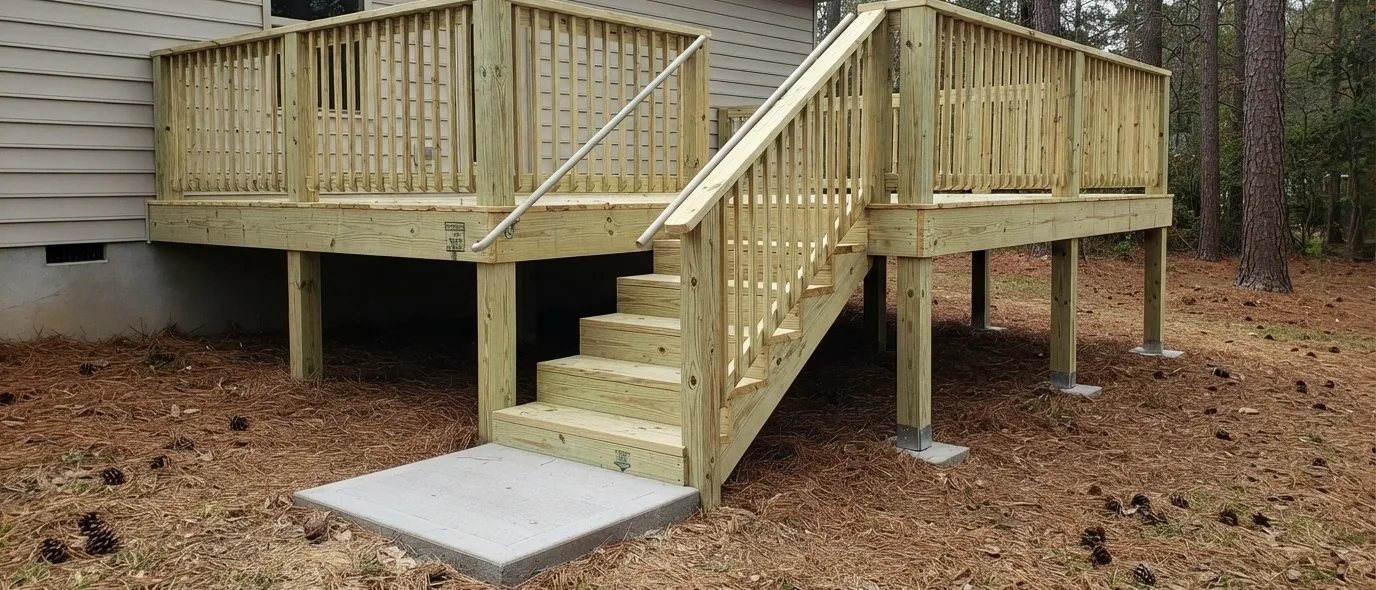
A pressure-treated deck in Columbia runs about $49 a square foot built, so a typical 200 to 500 square foot deck for a Midlands home lands somewhere between $9,800 and $24,500. That's a range, not a quote.
Where you land inside it is mostly about how the deck meets your house, how far off the ground it sits, and what's in the frame underneath. The deck boards are a smaller part of it than people expect. Two decks the same size can be thousands of dollars apart and look identical from the yard.
What you're actually buying at $49 a foot
A deck price is five prices stacked on top of each other:
- Footings and posts. Holes dug down to firm bearing soil, concrete, and the post bases that keep wood up off that concrete. Flat lot, small number. Sloped lot, not a small number.
- The frame. Beams, joists, hangers, blocking, bracing. A third of the lumber on your deck sits under your feet where you'll never look at it again.
- The connection to the house, or the extra beam and row of footings you need if there isn't one. That's the next section.
- The deck boards. The part everyone shops for, and the smallest share of the total.
- Railing and stairs. Priced by the linear foot and by the step, not by the square foot of deck. That's why small decks come in high per square foot and big ones come in low.
And a per-square-foot number does not scale down. A 10x10 deck is 100 square feet, and it still needs a permit, a crew mobilized to your yard, footings dug and poured, a beam, a stair, railing, and the wall opened if it's attached. Almost none of that gets smaller because the deck did. Spread across 100 feet those fixed costs land hard, so a small deck comes out well above the rate at the top of this page and a big one comes out under it. The number is a general figure, not a multiplier.
Height is the multiplier on all of it. A deck two feet off the ground and a deck eight feet off the ground use the same decking, and they are not the same job: taller posts, bigger footings, bracing, a full stair run, and railing you now have to have instead of railing you chose.
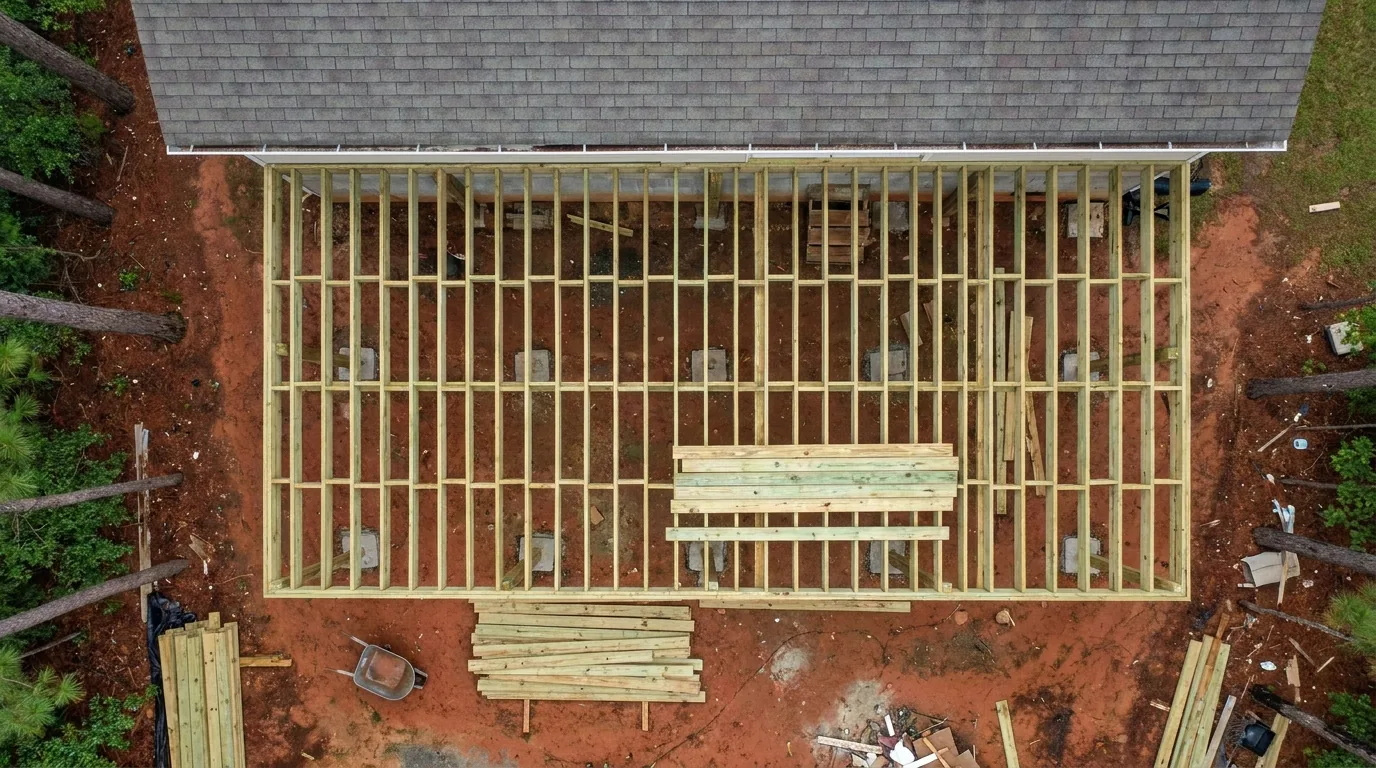
Attached or freestanding
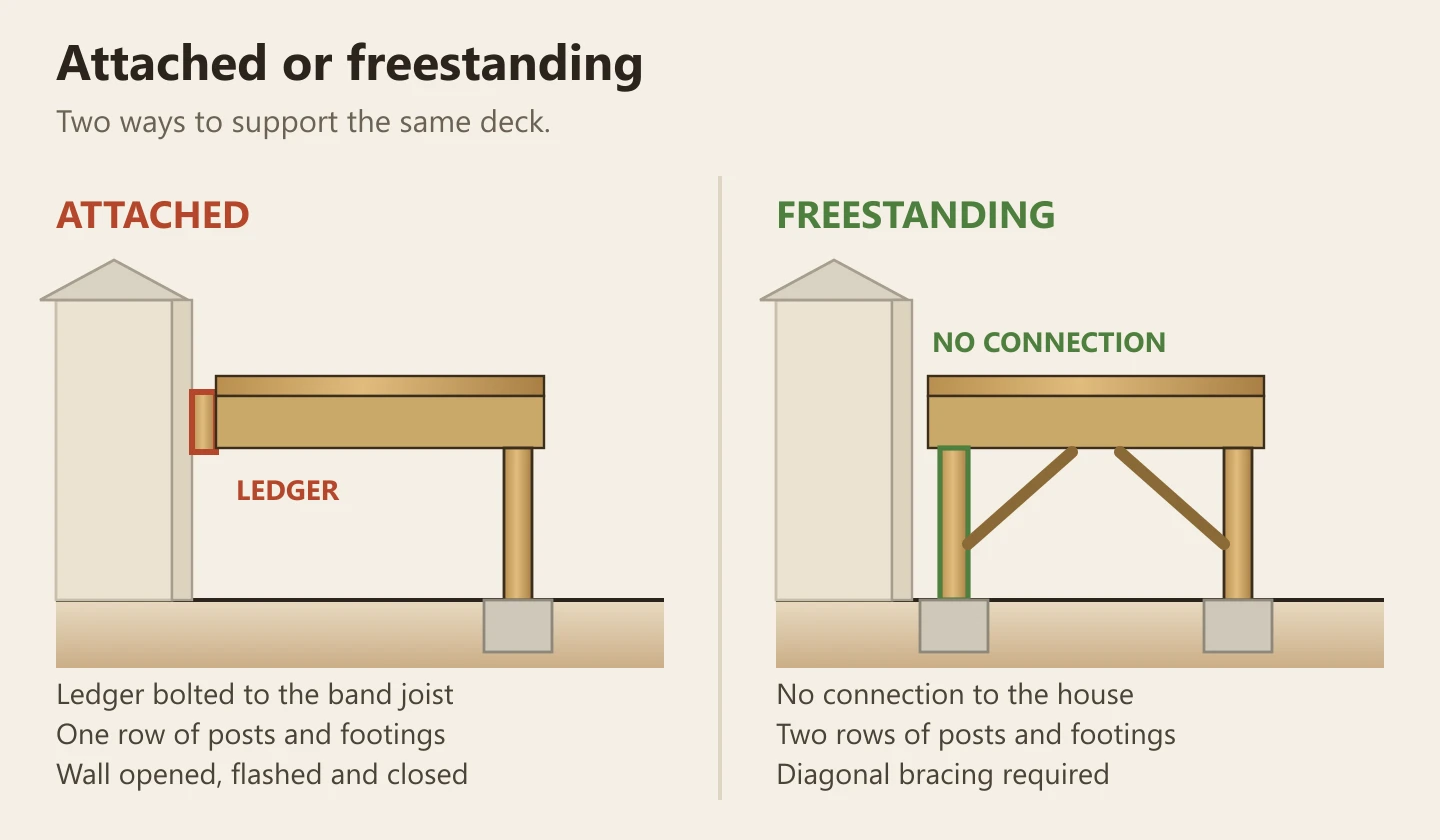
Every deck is one of two things. It either hangs off your house, or it stands on its own next to it. Most quotes never say which one you're getting, and the two are not the same price.
What a ledger is
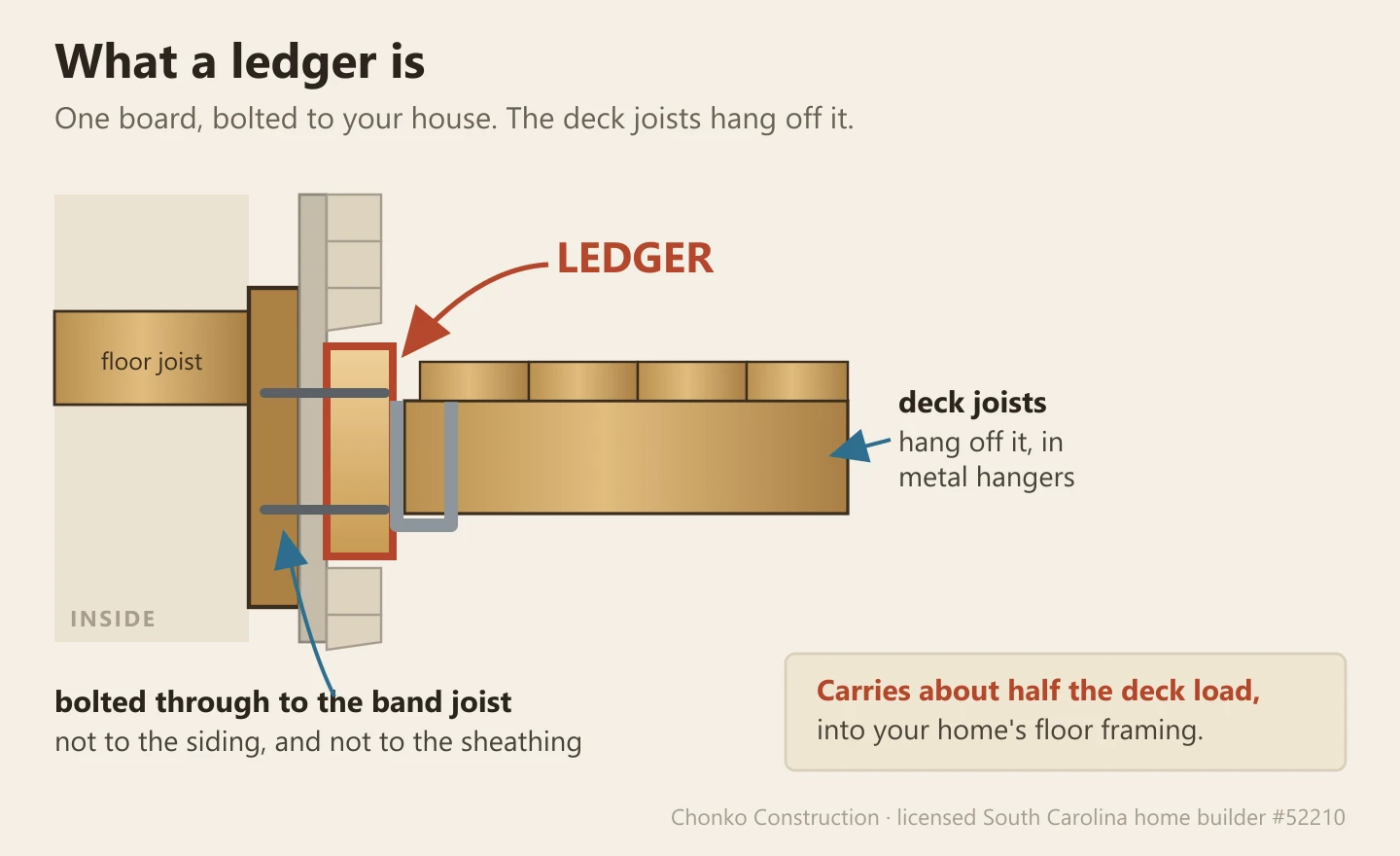
A ledger is one treated board, usually a 2x8 or a 2x10, bolted flat against the side of your house so the deck joists can hang off it. That's it. One board.
That one board carries roughly half the weight of the deck, everything on it, and everybody standing on it, and it hands all of that to your home's floor framing. It's also a connection that fails all at once rather than slowly, which is why it gets the attention it does from inspectors and from anyone who has seen one come off a wall.
Why the ledger costs real money
Because installing one means opening your house up.
- The siding comes off along the full run of the deck.
- The band joist behind it, the rim board at the edge of your floor system, gets exposed and looked at. If it's soft, that's a repair before anything gets bolted to it.
- Flashing goes in, in an order that only works one way (below).
- The fasteners are structural, sized and spaced in a staggered pattern for the load, and coated or stainless because treated lumber eats plain steel. Not nails. Not a lag screw into sheathing.
- Lateral load hardware ties the deck frame back through the wall to the floor joists inside.
- The siding goes back on so it sheds water over the flashing instead of behind it.
That's a day of work on a wall nobody planned to touch, done in a sequence that can't be corrected later without pulling the deck apart.
What that actually adds up to
Here is the shape of it in round numbers. A 100 square foot deck framed and decked at $49 a foot is about $4,900 of deck. Attach that same deck to a lap-sided wall and flash it properly, and the finished job lands nearer $9,800. On a small deck the wall can be about half of what you pay.
That sounds absurd until you notice what the ledger is priced by. It's priced by the length of wall you open, not by the size of the deck. Opening 12 feet of wall, checking the band joist, flashing it and closing it back up costs roughly the same whether there's a 100 square foot deck hanging off it or a 400 square foot one. So it's a large share of a small deck and a small share of a big one. That's part of why small decks come in high per square foot and large ones come in low.
The wall you have moves it again. Every one of these is buildable. What changes is how, and how much:
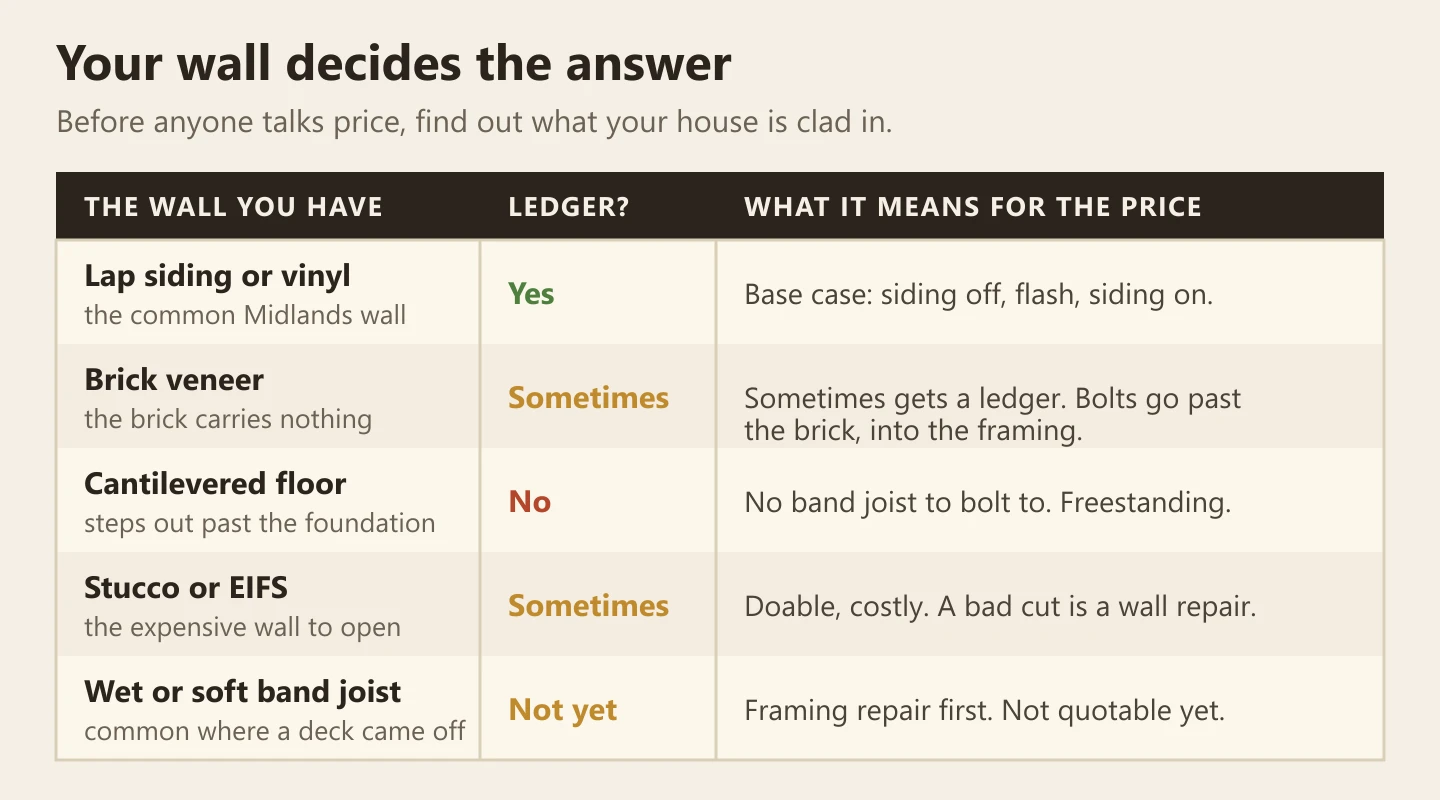
None of this is a line item on our quote. We don't sell a ledger separately and these aren't menu prices. They're here so you can look at a deck bid and know roughly which part of it is the deck and which part is your house.
Why we build freestanding sometimes, and why it isn't the cheap way out
A freestanding deck skips the house. An extra beam on its own row of posts and footings runs where the ledger would have gone, and the deck stands by itself.
It's not the budget version. You're trading a day of flashing work for two or three more footings, another beam, and the diagonal bracing that keeps the whole thing from racking. Sometimes it costs more. It's frequently the better build, and on a couple of houses it's the only honest answer:
Brick veneer is the one people get wrong in both directions. A lot of Columbia is brick, and the brick itself carries nothing: it's a skin hung on the framing, so a ledger fastened to the brick is fastened to nothing. That doesn't mean you can't attach a deck to a brick house. It means the fasteners have to run past the veneer and into the framing behind it, on sleeves that keep the load off the brick and keep the air gap behind it open. It's a real detail, it's more work than lap siding, and it's the one a hurried crew gets wrong. The chart above has the rest of them.
The question to ask before you sign anything
Ask every bidder the same thing: is this deck attached or freestanding, and does the price I'm holding include the ledger and its flashing?
If a bidder hasn't decided yet, that decision gets made later on site, and it gets made by whoever is holding the saw. Worth knowing before you sign rather than after.
Permits, and who is allowed to build this
In Columbia, Lexington County and Richland County a deck needs a permit when it's more than 30 inches above the ground at any point, when it's attached to the house, or when the contract value goes over $5,000. Between those three, nearly every real deck is permitted work.
The attachment is also a licensing question, not just a paperwork one. Bolting a deck to your house makes it a structural addition to the dwelling. Under S.C. Code § 40-59-10 that's work for a licensed Residential Builder, and a Residential Specialty Contractor can't build a structural addition without a licensed builder supervising it. A crew that can legally build you a freestanding deck in the yard may not be able to legally attach one to your house.
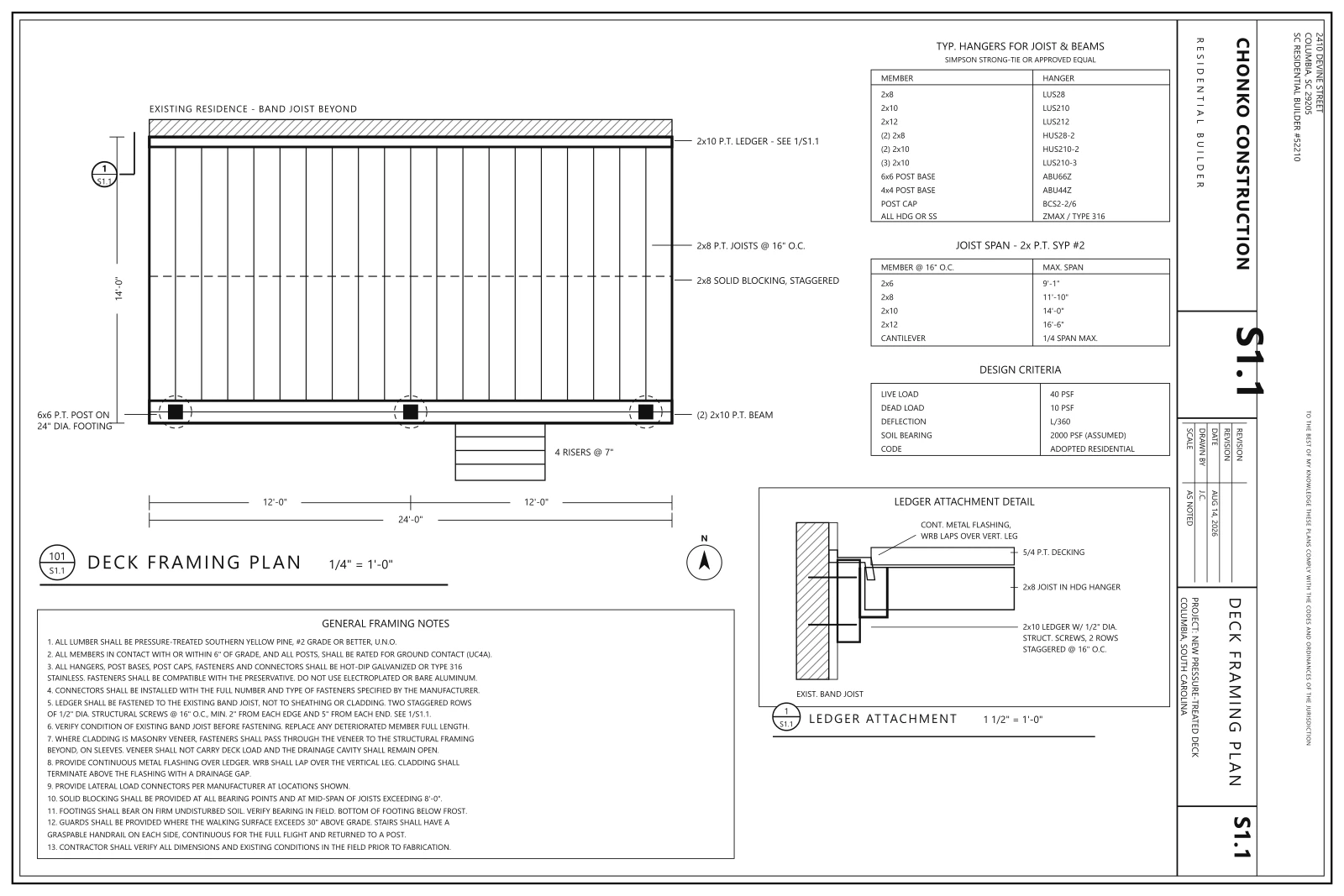
A permit application isn't a form you sign, either. It's a drawing set: a framing plan with the joist and footing layout, the structural notes, and the dimensions, so a plans reviewer can check the deck before it exists rather than after.
If you're bidding this out, the license type matters more than the license number. There's a full walkthrough in the deck permit guide, including the owner-builder exemption and how to check a builder against the state database.
Treated wood, and the parts of it worth knowing
Nearly every treated deck in the Midlands is southern yellow pine run through a copper-based preservative. It's the right material here and it's cheap, and it has habits you should know about before you own one.
- There's more than one grade, and they're not interchangeable. Above-ground lumber is rated for joists, decking and railing. Ground-contact lumber is a heavier treatment, and it's what belongs anywhere within about six inches of the soil or holding the structure up. A frame built entirely from the above-ground stuff costs less and is a shorter deck.
- It corrodes steel. The copper that keeps the wood from rotting will chew through plain fasteners and plain hangers, and it reacts with bare aluminum. Everything touching treated wood has to be hot-dip galvanized, stainless, or coated for the job. This is a real cost line and it's an easy one to shave off a bid.
- It shows up wet. Fresh treated lumber is heavy with water. It shrinks, it cups a little, and it checks (those surface cracks) as it dries. That's the material behaving normally, not a defect.
- Sealing it on day one gives you a blotchy deck. You can do it, nothing stops you, but wet boards take stain unevenly and you see it for years. Let it dry out first and it goes on even. After that it's every couple of years, forever, if you want it to stay the color it started. That upkeep is a real part of the difference between wood and composite, on top of the price per foot.
Framing, and what gets left out of a cheap bid
Everything structural on a deck is buried by the time you see it, so it's hard to check and easy to trim.
- Joist spacing. 16 inches on center is standard under treated decking. Stretch it and the boards get springy, and you feel it in year one.
- Beam and footing sizing. Both are set by how much deck is leaning on them and how far it spans. Undersized is invisible until the deck starts to sag between posts.
- Hangers and hardware. Joist hangers, post bases, tension ties. All of it rated for treated lumber, all of it fastened with the nails or screws the hanger was tested with, not whatever's in the pouch.
- Blocking and bracing. Blocking between joists over the beam and diagonal bracing on tall posts are what stop a deck from moving under you. They're also the first two things to disappear from a bid.
- Footings to bearing soil. Dug to firm ground, not to loose fill, and sized for the post above. A shallow footing looks identical from the yard right up until one corner settles.
There's more on the post-and-footing end of this in above-grade footers vs. buried deck posts, which covers how the base of a deck holds up in red clay.
The ground under the deck
What's underneath an open deck is a real line item, and it often gets left off a bid because from the yard it looks like nothing. It's worth deciding on before you sign, not after.
- Grading and dirt. If water runs toward the house or ponds under the deck, that's fixed while the ground is open and reachable, not later through a two-foot crawl space. Cutting a slope away from the house is an excavation cost and it's the cheapest it will ever be on the day the frame is going up.
- Gravel, and what it actually buys you. Stripping the topsoil and putting down washed stone under the deck does three things at once: water drains through instead of sitting, air moves under the frame so the underside of the boards dries out, and nothing grows up into it. Damp still air under a deck is what shortens a treated frame, and gravel is the cheap version of fixing that.
- Fabric under the stone. A layer of landscape fabric under the gravel keeps the stone from disappearing into the clay and keeps weeds from coming up through it. It's a small material cost that decides whether you're pulling saplings out from under your deck in year three.
- Do it in the right order. All of this is easy while the frame is open overhead and impossible once the boards are down and you're on your stomach in the dark. If it isn't on the quote, ask what the plan is for it.
Replacing a deck? Price the teardown before you price the build
Most deck work in the Midlands is replacement, not a first deck, and the old one has to come off before anything else starts. That's a real share of the job and it's the part homeowners are most surprised by, because from the yard it looks like an afternoon.
- Access decides the price, and it's decided before we quote. If a machine can reach the deck, a mini skid steer through a side gate or around the house, the teardown is hours. If it can't, it's hand demolition: board by board, screw by screw, carried out to the drive. A privacy fence with a 36-inch gate, a walk-out basement, a steep side yard, a pool, a septic field or a neighbor's fence line can each turn a half-day machine job into two days of labor. Walk your own side yard before you get bids and you'll know which one you're buying.
- Disposal is billed by weight and it isn't small. Treated lumber can't be burned and nobody wants it for scrap, so it goes to a landfill and you pay by the ton. A deck's framing, decking, railing and stairs is usually more than one load, and old concrete footings are heavy out of all proportion to their size.
- The old footings are their own decision. Digging them out is a separate job with its own labor and its own disposal. Leaving them buried is cheaper, but they then dictate where the new posts can go, and if the old spacing was wrong the new frame inherits the problem.
- You find out what's behind the wall on teardown day. The band joist the old ledger was bolted to has been covered for twenty years, usually with flashing that was done wrong or not done at all. If it's soft, that repair happens whether it was in the bid or not. A builder who has priced a few of these will tell you it's a possibility up front rather than discover it in front of you.
If demolition is one line on a bid with nothing behind it, ask what's in it. It's a common source of change orders.
What an online price can and can't tell you
A per-square-foot figure from an online calculator is a useful starting place, and it's genuinely all it's built to be. Those numbers describe a rectangle: flat ground, low to the earth, plain railing, no attachment to the house, no permit, and a national average labor rate.
Yours has a slope, a height, a wall and a jurisdiction. Any one of them can move the total by thousands, and none of them are inputs on a calculator. The same is true of the number on this page: it's real for the deck we usually build here, and it still isn't your number until somebody has stood in your yard and looked at your band joist.
If you want to narrow it yourself before you call anybody, how to measure a deck walks through the three numbers (square footage, shape, and height off the ground) that actually change the price.
The rest of the deck guides
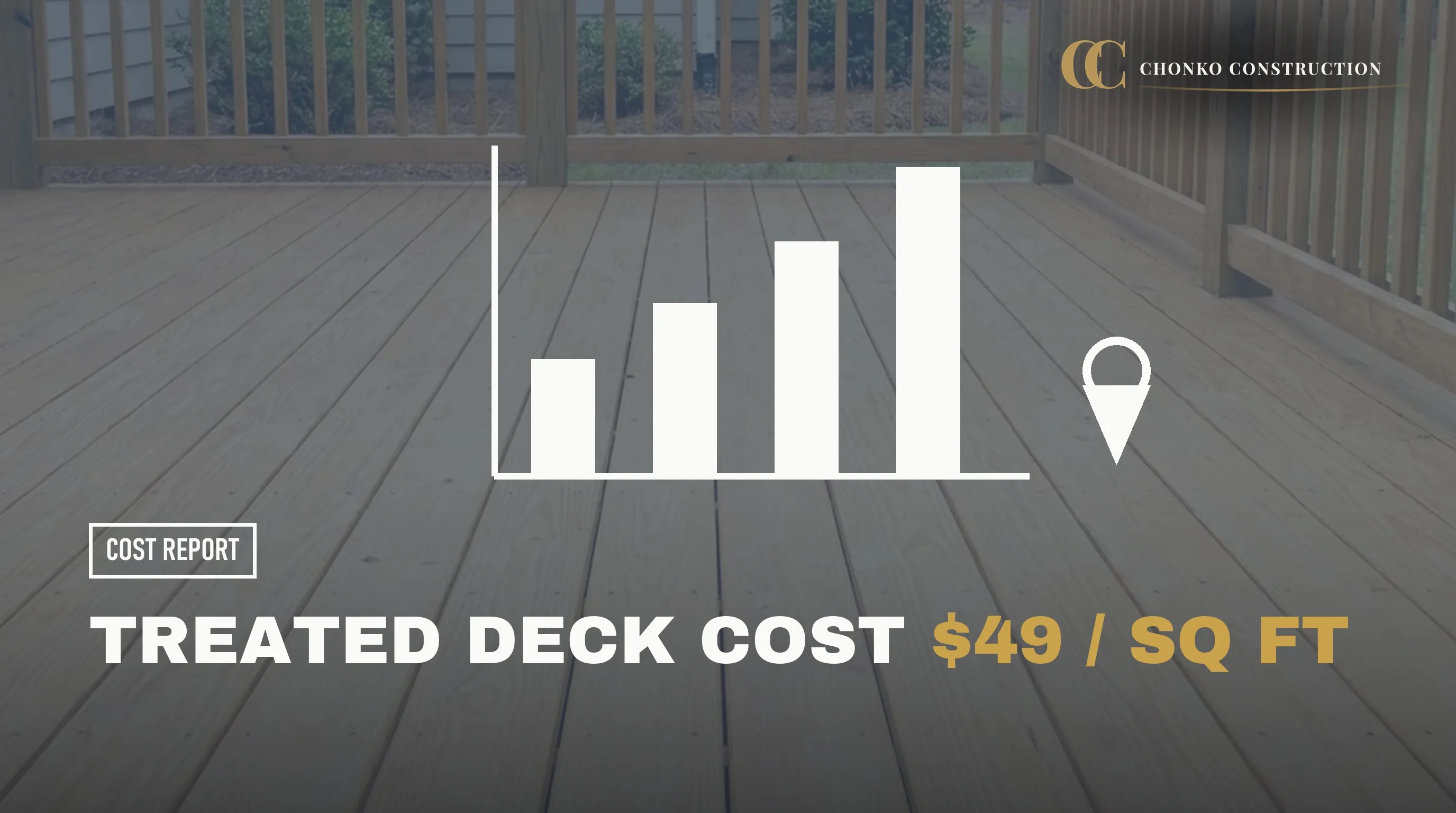
Pressure-Treated Deck Cost in Columbia, SC
The material on its own, and what the upkeep really adds up to over the life of the deck.
Read the guide arrow_forward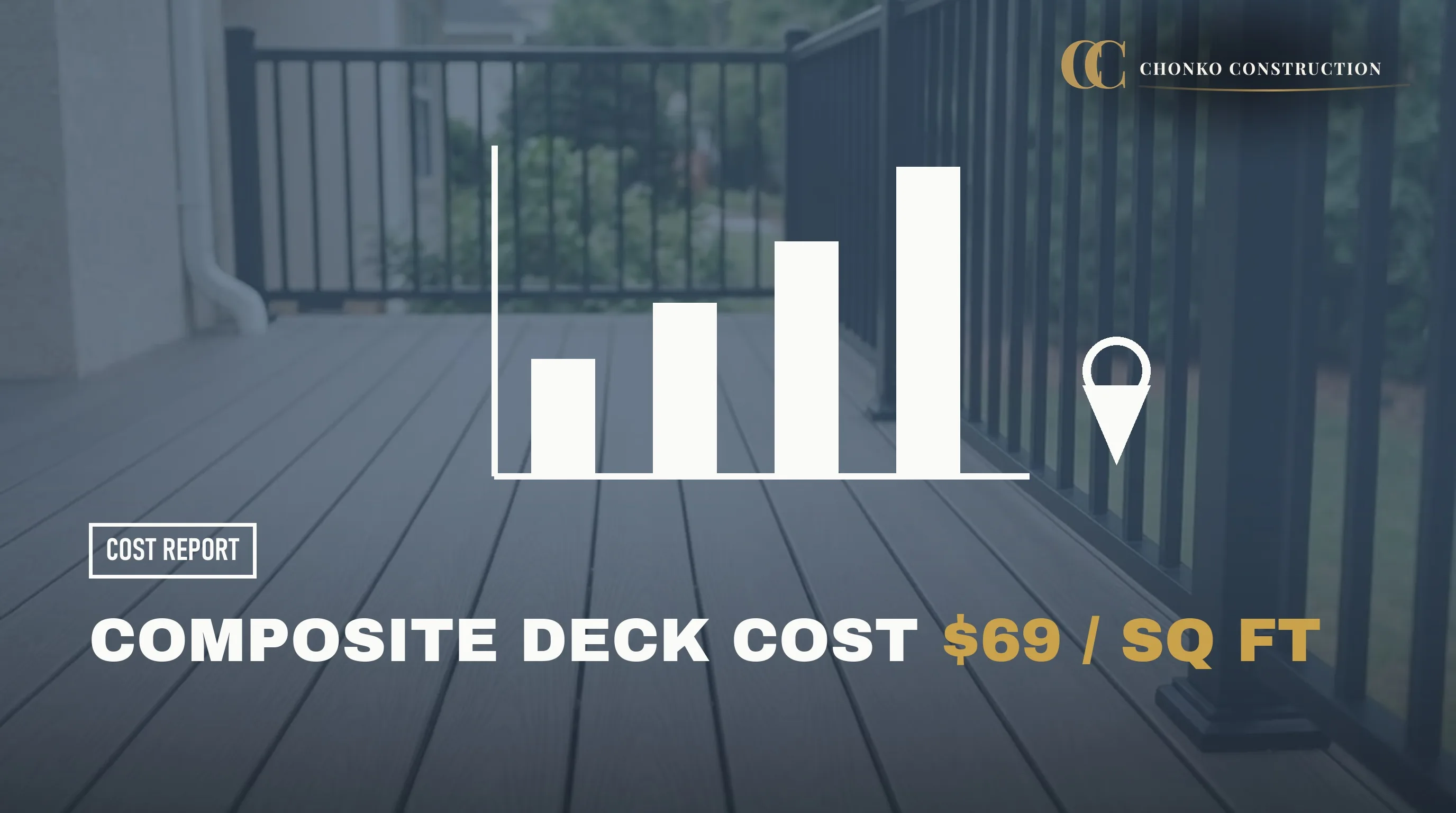
Composite Deck Cost in Columbia, SC (2026 Guide: Trex, TimberTech, Fiberon & More)
Board lines from Trex, TimberTech, Fiberon, Deckorators and Azek, compared.
Read the guide arrow_forward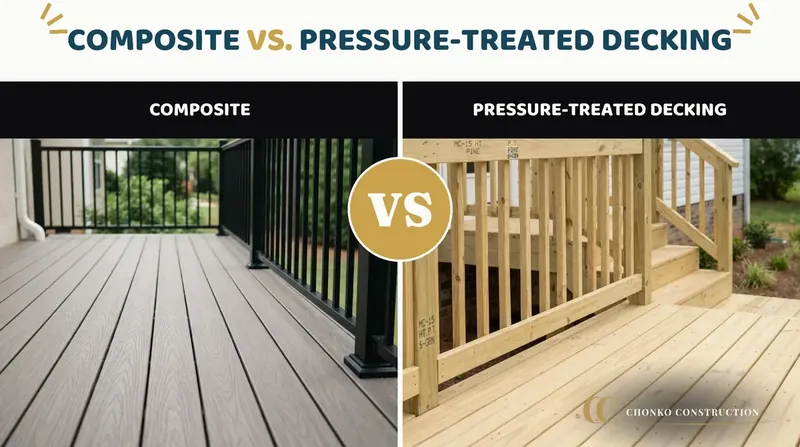
Composite vs. Pressure-Treated Decking in Columbia, SC
The straight comparison: cost, upkeep, lifespan and heat underfoot in South Carolina sun.
Read the guide arrow_forward
Multi-Level & Elevated Deck Cost in Columbia, SC
For when height and slope are driving the number harder than square footage is.
Read the guide arrow_forward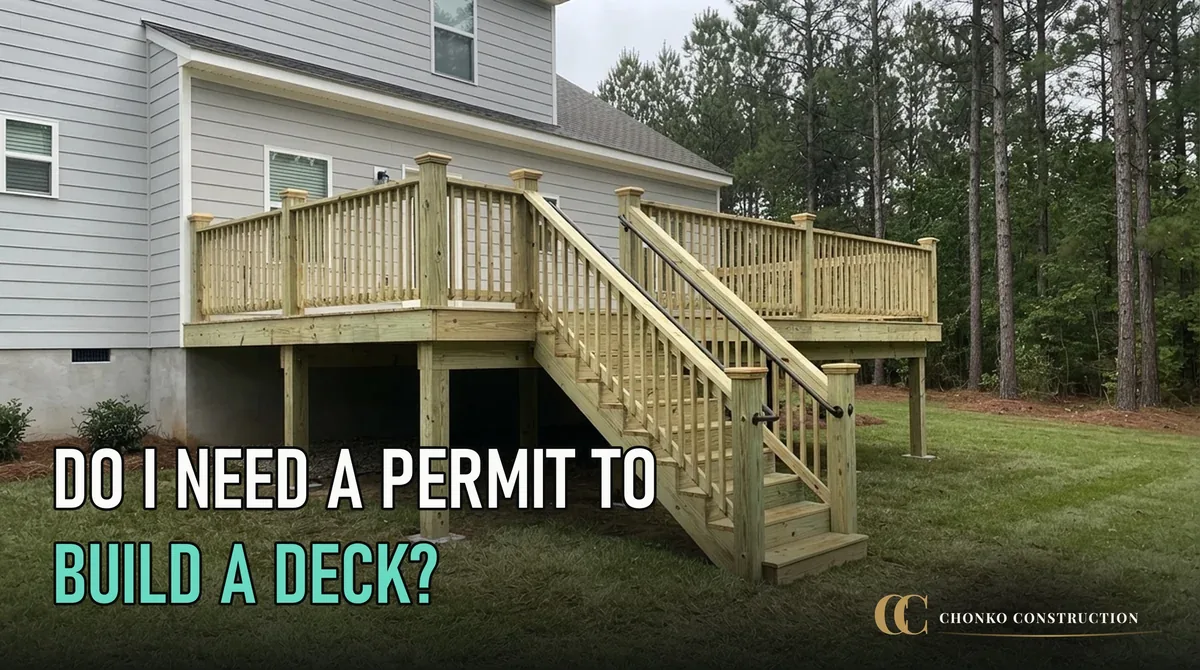
Do I Need a Permit to Build a Deck in Columbia, SC?
The 30-inch rule, the $5,000 rule, and who is allowed to pull it.
Read the guide arrow_forward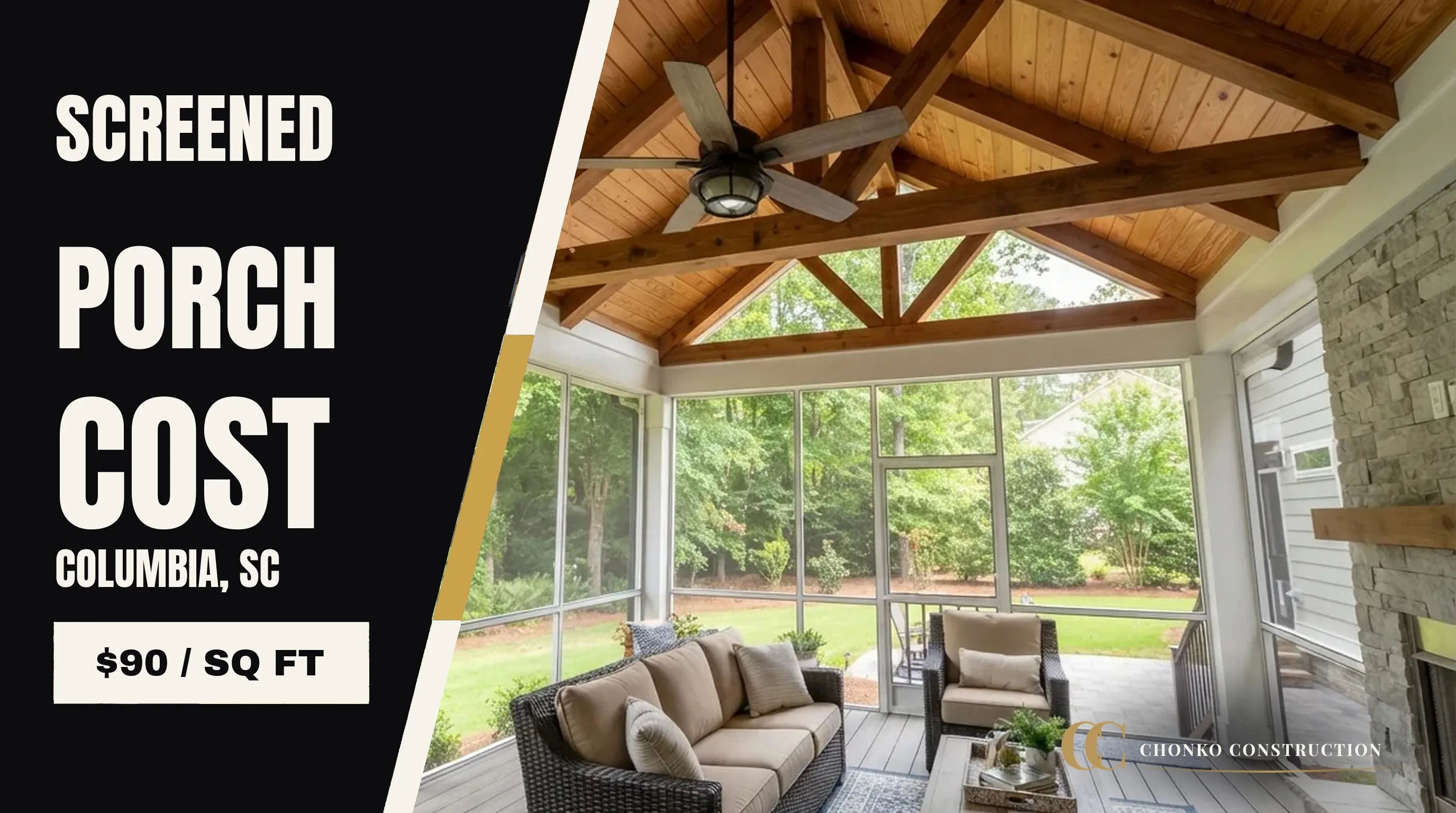
Screened Porch Cost in Columbia, SC (2026 Builder's Guide)
If what you are describing actually has a roof on it.
Read the guide arrow_forwardWant a real number for your yard? Book a free phone consultation. We build decks across Columbia and the Midlands, and we'll go through the height, the wall and the access before anybody talks price.
Frequently Asked Questions
How much does a pressure-treated deck cost in Columbia, SC?add
About $49 per square foot built, so a typical 200 to 500 square foot deck lands between roughly $9,800 and $24,500. Height off the ground, whether the deck attaches to the house, and the amount of railing and stairs are what move you inside that range. It's a typical range, not a quote.
What is a deck ledger, and why does it cost so much?add
The ledger is the single treated board bolted flat to your house that the deck joists hang from. It carries about half the deck's weight and hands it to your floor framing. It costs money because installing one means taking the siding off, exposing and inspecting the band joist, flashing the connection in a specific order, using structural fasteners and lateral-load hardware, and then closing the wall back up. It's a day of work on a wall that wasn't otherwise part of the job.
Is a freestanding deck cheaper than an attached one?add
Not usually. Going freestanding trades the flashing work for two or three extra footings, another beam, and diagonal bracing, so it often costs the same or more. It's the right build on a cantilevered floor or where the band joist is already soft, because there's nothing sound back there to attach to. On brick veneer it's a judgment call rather than a rule: attaching is doable, but the fasteners have to run past the brick into the framing behind it, and freestanding is often the cleaner answer.
Do I need a licensed builder to attach a deck to my house?add
Yes. Attaching a deck makes it a structural addition to the dwelling, which under S.C. Code § 40-59-10 is work for a licensed Residential Builder. A Residential Specialty Contractor can't build a structural addition without a licensed builder supervising. A crew that can legally build a freestanding deck in your yard may not be able to legally bolt one to your house.
Does a deck need a permit in Columbia?add
Usually. In Columbia, Lexington County and Richland County a permit is required when the deck is more than 30 inches above grade at any point, is attached to the house, or has a contract value over $5,000. Most real decks hit at least one of those.
Why is the price on a national deck cost calculator lower than a real bid?add
Those figures price a rectangle on flat ground, low to the earth, with plain railing, no attachment to the house, no permit and a national average labor rate. Slope, height, the wall connection and your jurisdiction can each move the total by thousands, and none of them are inputs on a calculator.
Should I put gravel under my deck?add
On an open deck, yes, and it's cheapest to do it on the day the frame goes up. Stripping the topsoil, laying landscape fabric and putting washed stone down means water drains through instead of standing, air moves under the frame so the underside of the boards dries between rains, and nothing grows up into it. Damp still air is what shortens a treated frame. Once the deck boards are down, the same work is done on your stomach in the dark and costs several times as much.
How much does it cost to tear off an old deck?add
It's decided almost entirely by access and by weight. If a machine can reach the deck, through a side gate or around the house, the teardown is hours. If it can't, it's hand demolition carried out to the driveway, which is days. Disposal is billed by the ton and treated lumber can't be burned or given away, so a deck's framing, boards, railing and old concrete footings is usually more than one load. Walk your own side yard before you take bids and you'll know which version you're buying.
How long does a pressure-treated deck last here?add
The boards and railing are the wear items and they're replaceable. The frame and the base are what carry it: ground-contact-rated lumber where it belongs, hardware rated for treated wood, and posts that don't sit in wet clay. Get those right and you're replacing surface boards eventually rather than rebuilding the deck.
Have a project in mind?
See the full scope and pricing, or book a free phone consultation. No estimate pressure.