

Cost Guide
Wood Fence Cost in Columbia, SC (2026)
A wood fence in Columbia starts at about $37 a linear foot installed, so a typical 150 to 300 foot yard starts around $5,550. What the posts, the style and the upkeep actually cost.
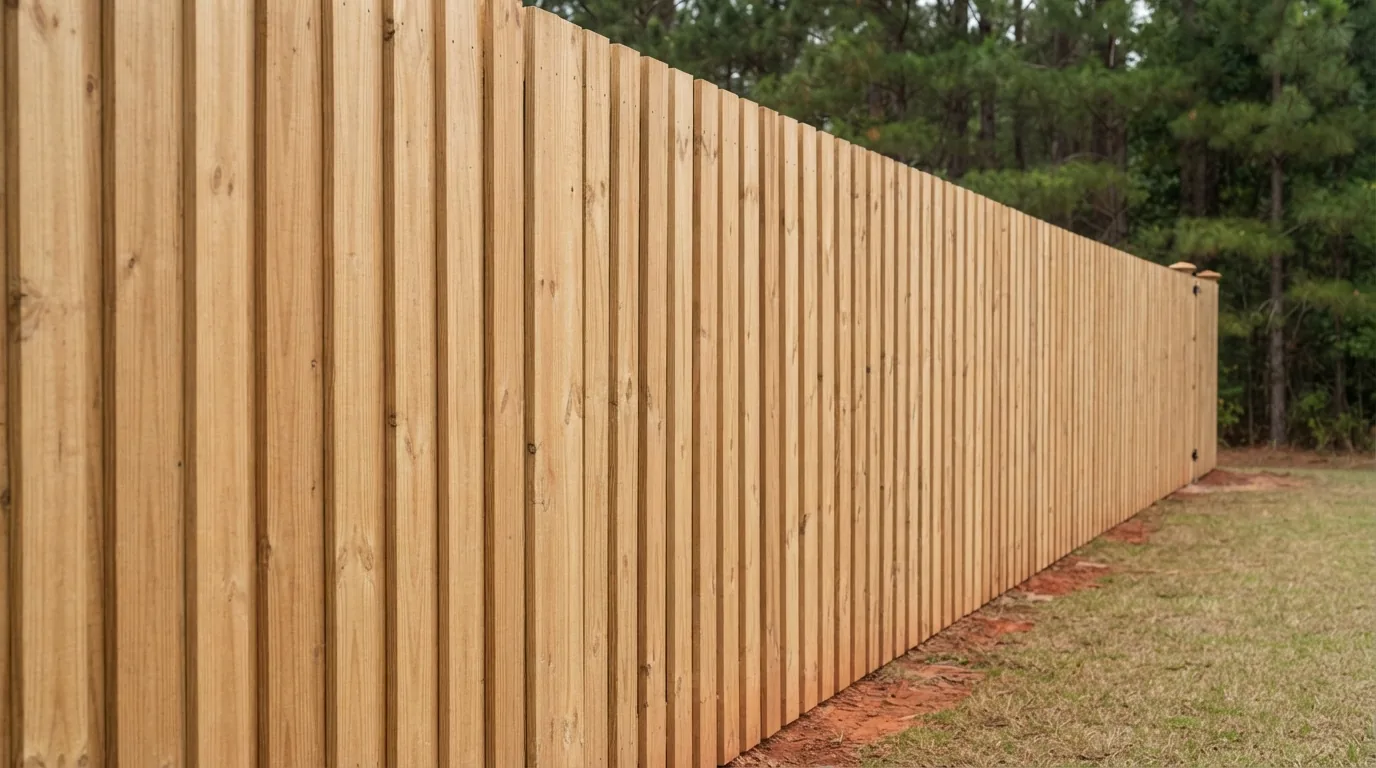
A wood fence in Columbia starts at about $37 a linear foot installed, so a typical Midlands yard of 150 to 300 feet starts around $5,550. That is a starting point, not a quote.
Wood is the Midlands default, and it is the material with the widest spread inside itself. Two wood fences of the same height and the same length can be thousands of dollars apart, because "wood fence" describes about ten different builds. What follows is which decisions move the number.
What you are paying for at $37 a foot
Almost none of a wood fence price is the boards you can see:
- Posts and concrete. Holes dug below the topsoil into firm ground, a 4x4 or 6x6 set in each one, and concrete around it. This is the part that decides whether the fence is standing straight in ten years.
- Rails. Two of them up to six feet, three above six feet or on an exposed run. They cross the face of the post and overlap it at each end.
- Boards. The part everybody shops for, and the smallest share of the total on most styles.
- Gates. Priced per gate, not per foot, and a real one costs more than people expect.
- Layout. Every corner, every end, and every gate needs its own post and its own concrete. A yard with six corners costs more than a yard with two at the same footage.
Pine or cedar
Two real choices in the Midlands, and they are not close in price.
Pressure-treated pine is the standard. It is chemically treated to resist rot and insects, it takes stain well, and it is what most of the wood fence in Columbia is built from. Fresh treated pine comes to the yard wet, so it moves for the first season: boards cup slightly, gaps open a little, and a run that was dead uniform in week one looks slightly less so in month six. That is normal and it settles.
Cedar is the upgrade. It resists rot on its own without treatment, it is more dimensionally stable, and it holds a finish better. It also costs meaningfully more per board, and on a long run that difference is most of what separates a wood fence at the starting figure above from one well past it.
Either one will outlive an unmaintained fence of the other. The upkeep matters more than the species.
The style is a base pattern plus modifiers
This is the part that surprises people. A wood fence style is not one name off a list. It is a base pattern with modifiers bolted on, and each modifier has a price.
The base patterns:
- Dog-ear picket. Flat-topped boards with both upper corners clipped. The default, and the cheapest full-privacy build.
- Stockade. Boards butted tight with no gap. Full privacy, straightforward.
- Board-on-board. Boards overlapped so there is no sightline even after the wood moves and shrinks. It uses roughly a third more boards than a stockade of the same length, and it costs accordingly.
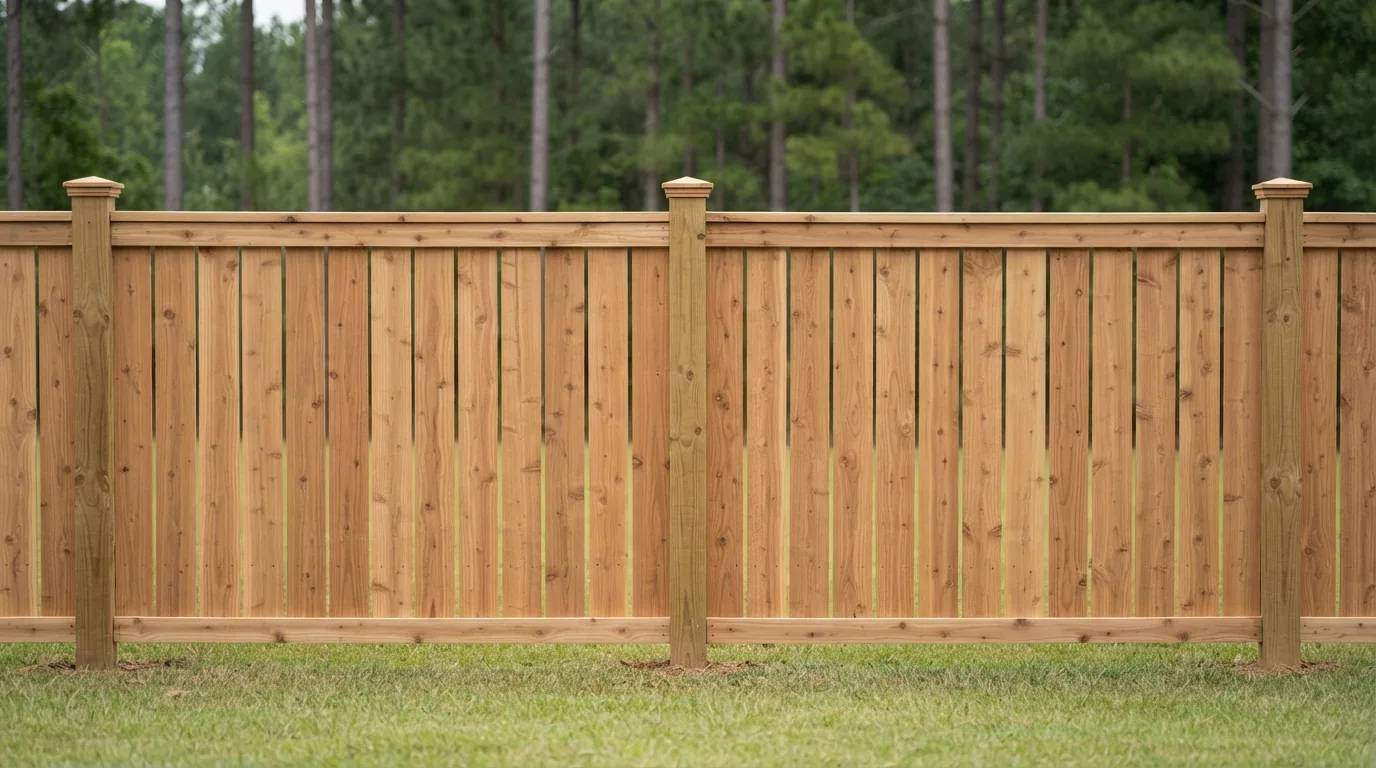
- Shadowbox. Boards alternate on both faces of the rails, with the post centered in the thickness of the fence. That sandwich is what makes it a box. It looks finished from both sides, which is why it is the one that settles neighbor arguments, and it lets a breeze through.
- Modern horizontal. Boards run horizontally. Cleanest look, most demanding build, because every seam has to land on a post and the lines have to stay dead parallel down the whole run.
- Spaced or scalloped picket. Open, traditional, for a front yard rather than a back one.
- Board and batten and split rail round out the list.
The modifiers, which stack on top of any of those:
- Framed. Trim that closes out each section: a top cap laid flat across the section, a smaller cap trim underneath it, sometimes a vertical 2x4 side cap at each end, and often a bottom runner rail. Four extra pieces per section, and it is the single biggest visual upgrade available on a wood fence.
- Posts hidden or posts showing. Run the rails and boards across the outside face of the posts and the finished side is one unbroken plane of boards. Set the boards between the posts instead and the posts read as regular vertical breaks down the line. Both are real; they are different fences.
- Height. Three, four, six, and sometimes eight feet. Going from six to eight adds a third rail as well as the extra board height.
- Board top cut. Dog-ear, flat, gothic, or a scalloped run.
- Finish. Left natural to grey out, stained, or painted.
Which side gets the good side
The finished face almost always points out, toward the street or the neighbor, and the rails and posts show on your side. That is the convention, and on most Columbia lots it is also what the HOA expects.
If that bothers you, shadowbox is the answer: it is built to read the same from both directions. It costs more than a dog-ear run and less than board-on-board, and it is the only style where nobody gets the back of the fence.
What the posts have to do
A wood fence fails from the ground up, every time, and it is the cheapest thing on the job to get wrong.
- Spacing is six to eight feet on center, evenly. Not tighter, not wider, and not mixed down the run. A line with a four-foot bay next to a nine-foot bay is not a design choice.
- Depth is what holds it. A fence is a sail: the wind pushes on the boards and levers all of it onto the posts. What resists that is embedment, the depth of the post and the undisturbed soil the concrete bears against. A post that did not go deep enough gives up a little ground at a time and starts to lean, and one leaning post drags every board attached to it out of line with it.
- Rails cross the face of the post. Nobody cuts a housing into a 4x4 to bury a rail flush. Face-mounted or toe-nailed, overlapping the post about two inches at each end.
- Seams land on a post. Wherever two boards butt end to end, the joint sits on a post and the two boards share it. A seam floating mid-span has nothing to fasten to.
- Caps are a real product. One clean flat-pyramid or French-gothic cap per post. A 45-degree cut across the top of a post is not a cap.
Gate costs
A gate is quoted per opening, not by the foot, and on a wood fence it is the line item most often underpriced.
The problem a wood gate has to solve is that it is a rectangle of boards hung off one edge. Gravity pulls the far corner down, and a plain rectangle has nothing resisting that, so it slowly racks into a parallelogram and the latch stops meeting the post. What stops it:
- A brace that runs the right way. A diagonal from the bottom corner on the hinge side up to the top corner on the latch side. It works in compression, pushing the far top corner up. Run the other direction it does nothing but add weight, and that is the single most common wood-gate mistake.
- Or a steel gate frame. A welded metal frame the boards get fastened to. It costs more than a braced wood frame and it is what a wide gate, a tall gate, or a gate that will be used every day should have.
- Hinges rated for the actual weight, not the hinges that came in the box. Three on anything six feet tall.
- A drop rod on a double, so the inactive leaf is pinned to the ground and the latch has something solid to catch.
The posts either side are the other half of the price. A gate post carries the whole leaf as a cantilever, so it goes deeper, often in a bigger footing, and on a wide or double gate it steps up in size from the line posts. A double drive gate is not two walk gates: it is two of the hardest-working posts on the property plus the hardware to keep both leaves square.
What moves the number: the width of the opening, the height, single or double, wood frame or steel frame, and whether the gate is somewhere it gets opened daily or twice a year.
The upkeep, honestly
Wood is the lowest up-front price and the only fence on the list that asks for anything after it is built.
Plan on a wash and a re-seal every couple of years. The Midlands combination of sun and humidity is hard on a finish, and a fence that gets sealed on schedule looks like a fence for fifteen to twenty years. One that never gets sealed goes grey, checks, and starts losing boards well before that.
If the honest answer is that you are never going to seal it, that is worth knowing before you buy, because it changes which material is actually cheapest over the time you own the house. Vinyl and composite both exist for exactly that buyer.
Tear-out
If there is a fence there now, pulling it is its own line item: the old posts come out with their concrete footings attached, and all of it has to go somewhere. Ask whether a quote includes the removal and the disposal, or whether it assumes an empty property line.
Permits, HOA, and the line itself
Columbia-area requirements vary by jurisdiction, and a fence has two separate approvals that people confuse: the permit, and the HOA. The HOA is often the stricter one, and it may dictate material, height, style, and which way the finished side faces.
The property line is the other one. A fence built on the wrong side of it is a survey problem and a neighbor problem at the same time, and it is far cheaper to settle before the posts go in. Measuring the run is the first thing we do on a walk.
What an online number can and cannot tell you
A per-foot figure tells you which material you are shopping for. It cannot tell you what your fence costs, because it does not know how many corners your yard has, how many gates you need, what the slope does, or whether there is a fence to pull out first.
Use the range above to sort wood against the other four materials. Get the actual number from someone who walked the line.
The rest of the fence guides
Fence Cost in Columbia, SC (2026 Price Guide by Material)
The hub: all five materials side by side, and what moves a fence price.
Read the guide arrow_forward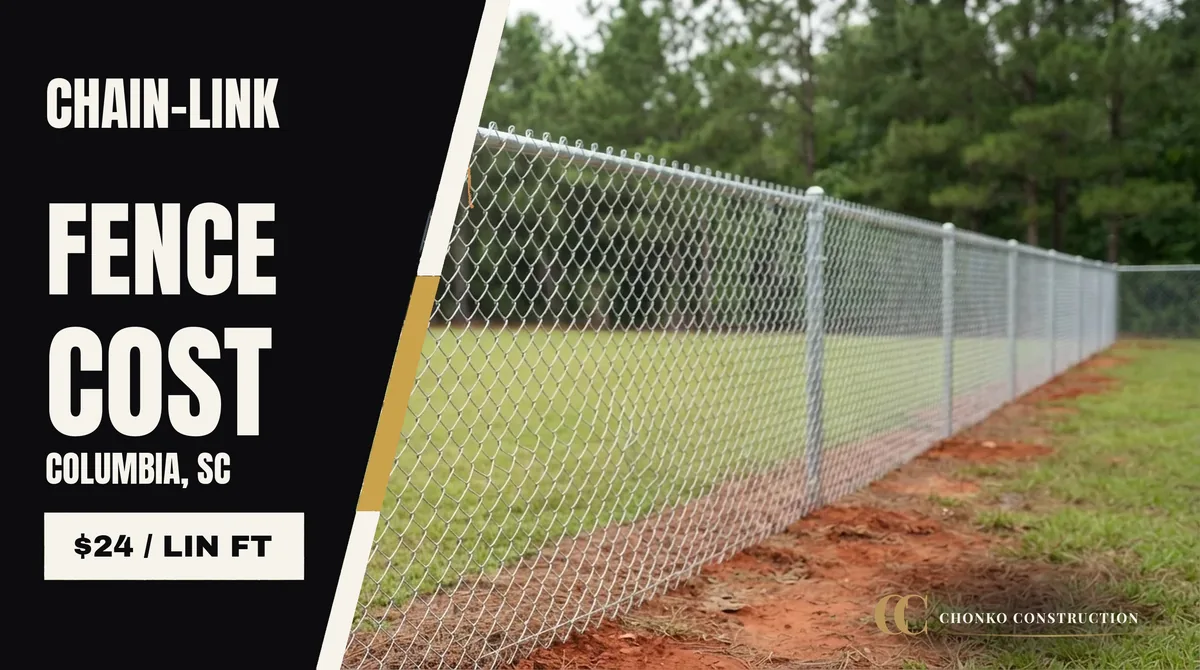
Chain-Link Fence Cost in Columbia, SC (2026)
The cheapest way to close in a yard, and where the money goes instead.
Read the guide arrow_forward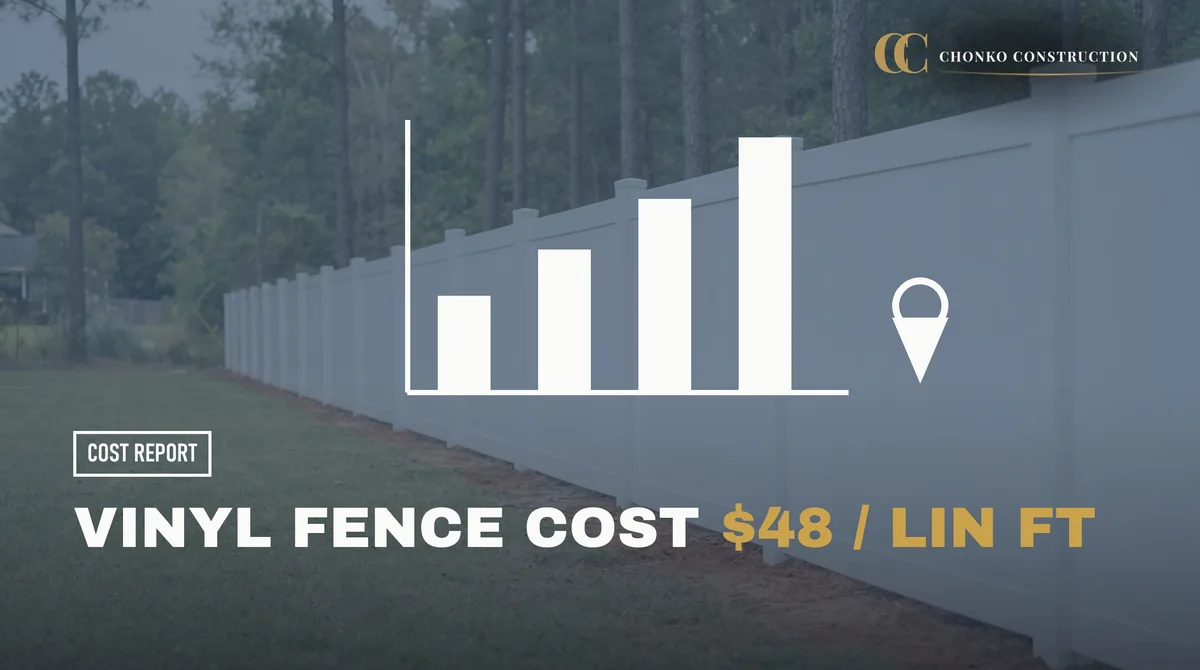
Vinyl Fence Cost in Columbia, SC (2026)
Wood's price without wood's maintenance, and the 19 styles available.
Read the guide arrow_forward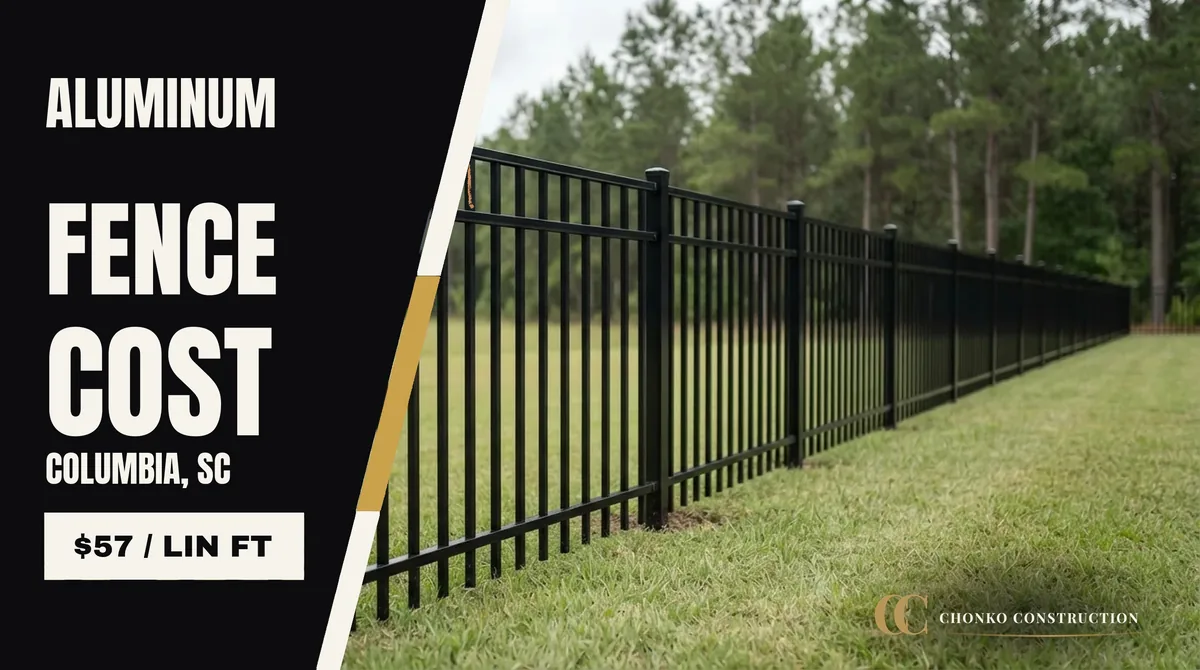
Aluminum Fence Cost in Columbia, SC (2026)
Ornamental, pool-code, and the one material that follows a slope without stepping.
Read the guide arrow_forward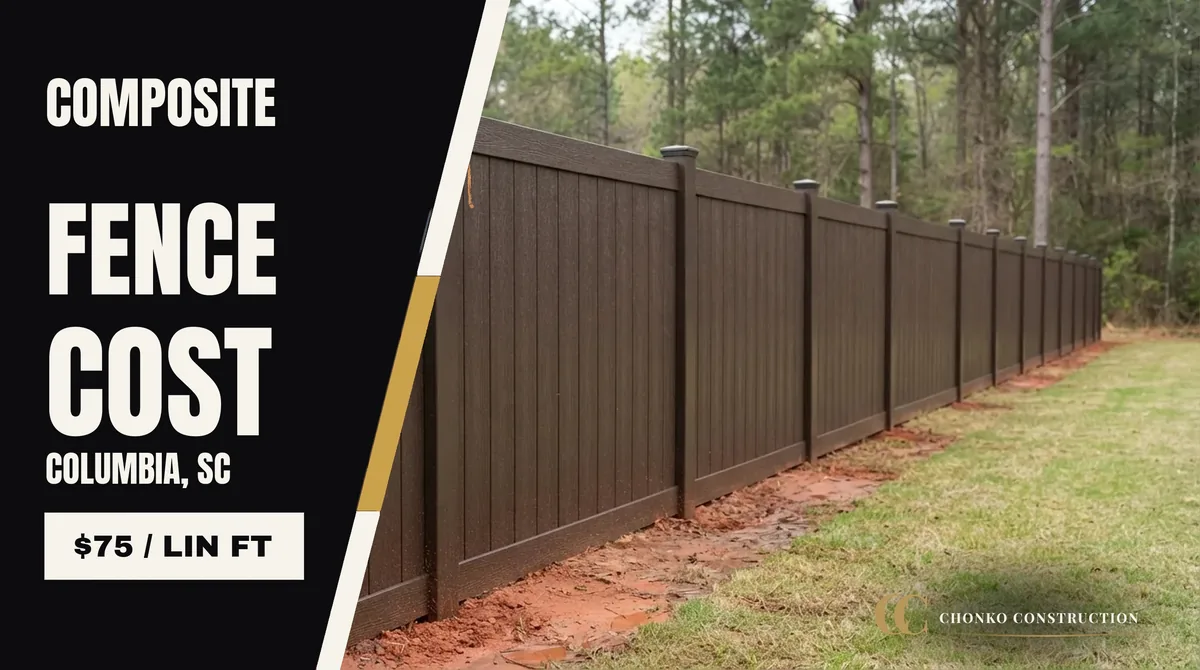
Composite Fence Cost in Columbia, SC (2026)
The stained-wood look that never gets stained. Three real brands, and that is all.
Read the guide arrow_forward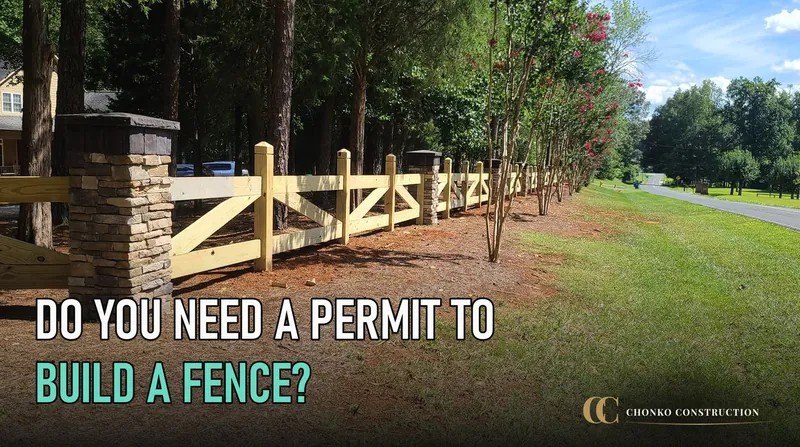
Do You Need a Permit to Build a Fence in Columbia, SC?
When a fence needs a permit here, and what the HOA gets a say in.
Read the guide arrow_forwardEvery material we install, with what each one actually costs.
Frequently Asked Questions
How much does a wood fence cost in Columbia, SC?add
A wood fence in Columbia starts at about $37 per linear foot installed, so a typical 150 to 300 foot yard starts around $5,550. Height, style, gate count, and how many corners the yard has all move it up from there. It is a starting point, not a quote.
Is cedar worth the extra money over pressure-treated pine?add
It depends on how you plan to maintain it. Cedar resists rot on its own, stays straighter, and holds a finish better, and it costs meaningfully more per board. Pressure-treated pine that gets washed and sealed every couple of years will outlast cedar that gets ignored. If you know you will keep up with it, pine is the better value. If you want the fence to look good with less attention, cedar earns the difference.
Which wood fence style is the cheapest?add
A dog-ear picket run at six feet, posts hidden, no framing, left natural. Every step from there adds material: board-on-board uses about a third more boards than a stockade the same length, shadowbox builds two faces, and a framed section adds a top cap, a cap trim, side caps and a bottom runner. Modern horizontal is the most demanding to build well, because every seam has to land on a post.
What is a shadowbox fence, and why does it cost more?add
Boards alternate on both faces of the rails with the post centered in the thickness of the fence, which is what makes it a box. It reads as finished from both sides, so no one gets the back of the fence, and it lets air through. It costs more than a dog-ear run because it is effectively two board faces instead of one.
Which side of a wood fence faces the neighbor?add
The finished side faces out, toward the street or the neighbor, with the rails and posts on your side. That is the convention and it is often written into HOA rules as well. If you would rather not have the framing on your side, shadowbox is the style that solves it, because it is built to look the same from both directions.
How far apart should fence posts be?add
Six to eight feet on center, at one consistent interval down the whole run. Tighter than six is wasted material; wider than eight lets the rails sag between posts. Mixed spacing, where one bay is four feet and the next is nine, is a sign the line was not laid out before the digging started.
How long does a wood fence last in South Carolina?add
Fifteen to twenty years for a fence built on properly set posts and washed and re-sealed every couple of years. Our combination of sun and humidity is hard on a finish, and a fence that never gets sealed greys, checks, and starts losing boards well before that. Posts set too shallow are the other clock: they lean the first wet winter and take the boards with them.
Does a wood fence quote include tearing out the old fence?add
Not always, and it is one of the most common gaps in a thin bid. Removal means digging the old posts out with their concrete footings still attached and hauling all of it off, which carries labor and a disposal fee. Ask any quote you are holding whether it prices an empty property line or the one you actually have.
Have a project in mind?
See the full scope and pricing, or book a free phone consultation. No estimate pressure.